

Table of Contents
- Chemical vs. Physical Exfoliants: What Aging Skin Needs
- Key Ingredients: AHAs, BHAs, and PHAs Compared
- How to Choose the Best Gentle Exfoliants for Your Skin Type
- Exfoliation Frequency for Mature Skin: Building a Safe Routine
- Signs of Over-Exfoliation and How to Recover
- Menopause, Medication, and Skin Barrier Health
- Frequently Asked Questions
Last Updated: September 27, 2026
Chemical vs. Physical Exfoliants: What Aging Skin Needs
Finding the best gentle exfoliants for aging skin starts with one shift in thinking: your skin no longer tolerates what it did at 30. This guide from Better Living Mosaic breaks down how to exfoliate mature skin without triggering irritation, redness, or barrier damage.
Chemical exfoliants dissolve dead cells with acids. Physical exfoliants buff them away with friction. For aging skin, chemical options win almost every time.
How Thinning Skin Changes the Rules
Skin thins with age. The epidermis loses volume, collagen production slows, and cell turnover stretches from roughly monthly to far longer. A scrub that felt refreshing in your thirties now creates microtears that take days to calm.
The American Academy of Dermatology notes that mature skin also produces less oil, which reduces its natural cushion against friction. That combination makes aggressive scrubbing a poor fit.
What most guides miss is that "gentle" is not about pressure. It's about chemistry, concentration, and how long an acid stays on your skin.
Key Ingredients: AHAs, BHAs, and PHAs Compared
The three acid families behave very differently on mature skin. Picking the right one matters more than picking the strongest one.
Alpha hydroxy acids (AHAs) like glycolic acid and lactic acid loosen the bonds between dead cells. Glycolic acid has the smallest molecule and penetrates fastest, which also makes it the most likely to sting. Lactic acid is larger and generally better tolerated.
Beta hydroxy acids (BHAs) like salicylic acid are oil-soluble, so they work inside the pore. That makes them useful if you still deal with clogged pores alongside fine lines.
Polyhydroxy acids (PHAs) such as gluconolactone have the largest molecules of the three. They sit closer to the surface, draw in hydration, and cause the least stinging. For reactive or sensitive skin, PHAs are usually the safest starting point.
Acid Type |
Example |
Penetration |
Best For |
|---|---|---|---|
AHA |
Glycolic, lactic |
Deepest |
Dullness, texture |
BHA |
Salicylic |
Pore-level |
Clogged pores, oil |
PHA |
Gluconolactone |
Surface |
Sensitive, reactive skin |
How to Choose the Best Gentle Exfoliants for Your Skin Type
Match the acid to your skin's current behavior, not to its behavior five years ago. That single rule eliminates most bad purchases.
Sensitive and Reactive Skin
Start with a PHA or lactic acid formula at a low concentration, once every seven to ten days. Patch test on your jawline for three nights before applying to your full face. If you feel stinging that lasts more than a minute, the formula is too strong for now.
For a non-acid option, the GlowEnzyme™ Facial Scrub Gel offers a rinse-off format that lets you control contact time completely.

Dry and Dehydrated Skin
Dry skin needs hydration alongside exfoliation, not instead of it. Look for lactic acid or mandelic acid paired with glycerin or hyaluronic acid in the ingredient list. Skip anything with added fragrance or alcohol high in the list.
Exfoliation Frequency for Mature Skin: Building a Safe Routine
Exfoliation frequency for mature skin should start at once per week and increase only if your skin stays calm for two full cycles. More is not better here, the barrier you are protecting rebuilds slowly, and a schedule that outpaces it produces the exact irritation you were trying to avoid.
A workable routine looks like this:
- Week 1-2: One application, evening only, on clean dry skin
- Week 3-4: If no redness or stinging, add a second weekly application
- Week 5+: Cap at two or three sessions weekly, never on consecutive days
- Always: Sunscreen the following morning, every time
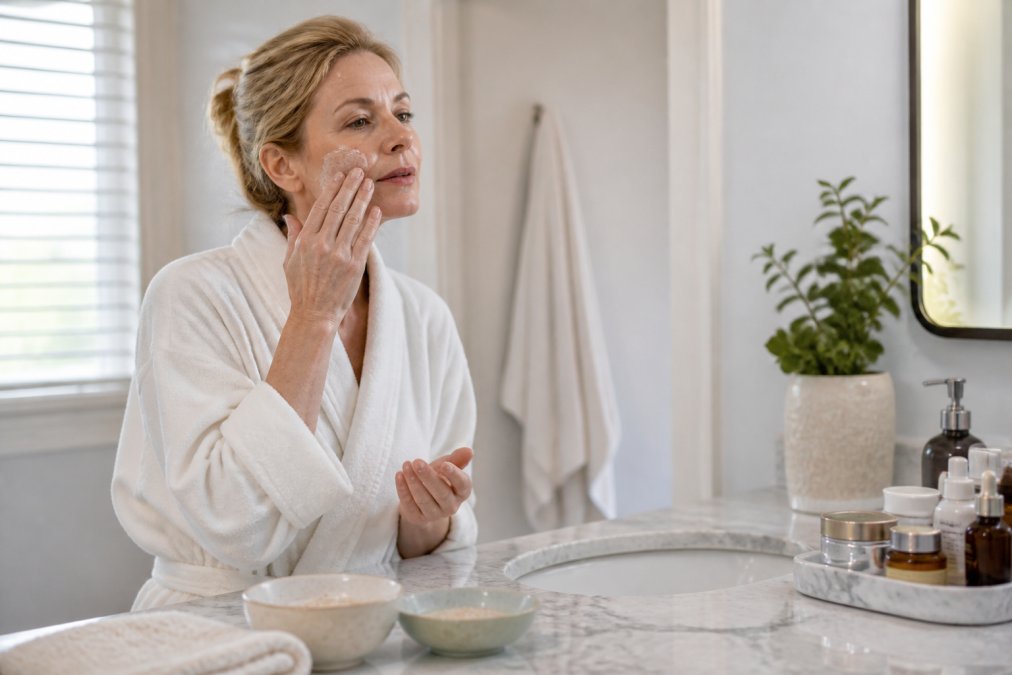
Evening application matters because AHAs and BHAs increase sun sensitivity. The Skin Cancer Foundation recommends daily broad-spectrum SPF 30 or higher regardless, but it becomes non-negotiable on exfoliation days.
Layering Exfoliants With Retinoids and Other Actives
This is where most guides go quiet, and it is where mature skin gets into trouble. A large share of readers over 40 are already using a prescription retinoid, a vitamin C serum, or both. Stacking an acid on top of those on the same night multiplies irritation rather than results.
The workable rule is separation by night, not by product:
GlowEnzyme™ Facial Scrub Gel →
- Retinoid nights: Cleanser, retinoid, moisturizer. No acid.
- Acid nights: Cleanser, exfoliant, moisturizer. No retinoid.
- Recovery nights: Cleanser, hydrating serum, moisturizer. Neither.
A three-night rotation, acid, recovery, retinoid, gives each active room to work without overlapping. If your skin is newly adapting to a prescription retinoid, pause exfoliation entirely for the first several weeks and reintroduce it only once the retinoid phase has settled.
Vitamin C is the exception that pairs reasonably well, but timing matters. Apply it in the morning and keep acids for the evening so the two never share a layer.
Prescription Topicals and Photosensitivity
Some prescriptions, including certain blood pressure medications, diuretics, and retinoids, increase photosensitivity or thin the skin. If you take daily medication, ask your pharmacist whether it affects sun sensitivity before adding acids to your routine. This is a two-minute question with a real payoff, and it is the single most useful step most readers skip.
Signs of Over-Exfoliation and How to Recover
The signs of over-exfoliation are easy to misread as progress. Stinging that lingers, tightness after rinsing, shiny patches, and sudden sensitivity to products you've used for years all point the same direction.
Other signals include:
- Flaking that appears in sheets rather than fine flakes
- Redness that doesn't fade within an hour
- Breakouts along the jawline in a pattern you've never had
- A stinging sensation when you apply plain moisturizer
Stop all exfoliation the moment two or more appear. Most cases settle within seven to ten days of gentle cleansing and heavy moisturizing.
Post-Exfoliation Recovery Protocol
Recovery is a protocol, not a pause. Follow it in order.
- Days 1-3: Cleanser, moisturizer, sunscreen. Nothing else.
- Days 4-7: Add a hydrating serum with hyaluronic acid or glycerin.
- Days 8-10: Reintroduce antioxidants like vitamin E.
- Day 11+: Resume exfoliation at half your previous frequency.
The ingredients that do the heavy lifting during recovery are the ones that rebuild the barrier rather than strip it further: ceramides, cholesterol, fatty acids, panthenol, and squalane. Look for a moisturizer that lists ceramides near the top rather than at the end of the ingredient list.
Handling Pigmentation After a Flare
Uneven tone is the change mature skin notices first, and it is also the one most likely to worsen if you push through irritation. Post-inflammatory hyperpigmentation deepens when skin is inflamed, so the recovery window is not downtime, it is the period that determines how even your tone looks afterward.
During recovery, keep two things in your routine: daily broad-spectrum SPF 30 or higher, and a gentle antioxidant in the morning. Both limit the pigment response that follows inflammation. Hold off on brightening acids until the barrier has fully settled, then reintroduce them at the lower end of your previous frequency.
For antioxidant support between exfoliation sessions, the Glimmer Goddess™ Organic Retinol Wrinkle Repair Face and Neck Cream is formulated with vegan, paraben-free ingredients. Introduce it on non-exfoliation nights only, and only once your skin has stopped reacting.

Pair your exfoliation nights with a recovery moisturizer.
Menopause, Medication, and Skin Barrier Health
Menopause brings a real drop in estrogen, and estrogen supports collagen production and the lipids that keep your skin barrier intact. That combination means many women notice their skin gets more reactive to exfoliating acids right around the same years they’re managing hot flashes and sleep changes, not because they did anything wrong, but because the skin underneath is genuinely thinner and slower to recover than it used to be. If you’re on daily medication, whether that’s a statin, a diuretic, or hormone therapy, ask your pharmacist whether it affects skin sensitivity or sun tolerance before you add or increase acid exfoliation. Treat this stage as a reason to go gentler and less frequent, not a reason to stop exfoliating altogether.
For antioxidant support between exfoliation sessions, the Glimmer Goddess™ Organic Retinol Wrinkle Repair Face and Neck Cream is formulated with vegan, paraben-free ingredients. Introduce it on non-exfoliation nights only.
Frequently Asked Questions
What is a good gentle exfoliator for older skin?
Look for polyhydroxy acids (PHAs) or lactic acid, which have larger molecules that sit on the surface and exfoliate without stripping the skin barrier. These are less irritating than glycolic acid and work well for mature skin that has thinned over time. A leave-on liquid or a wash-off gel applied once or twice weekly is usually enough. Always patch test first and follow with a hydrating moisturizer to support skin renewal.
How often should you exfoliate aging skin to avoid irritation?
Start with once a week and build up to two or three times weekly if your skin tolerates it. Exfoliation frequency for mature skin depends on the product strength and your barrier health. Signs of over-exfoliation, such as stinging, redness, or flaking, mean you should cut back. Many dermatologists suggest alternating exfoliation nights with recovery nights focused on hydration and barrier support.
What are the signs of over-exfoliation?
Signs of over-exfoliation include persistent redness, stinging when applying products, tightness, flaking, increased sensitivity to the sun, and breakouts along the jawline. If you notice these, stop all exfoliants for one to two weeks and use only gentle cleansers and moisturizers. Once your skin barrier recovers, reintroduce a mild exfoliant once weekly and monitor how your skin responds before increasing frequency.
Should mature skin use chemical or physical exfoliants?
Chemical exfoliants like AHAs, BHAs, and PHAs are generally gentler on mature skin because they dissolve dead cells without friction. Physical scrubs with rough particles can cause micro-tears on thinning skin. If you prefer a physical option, choose a non-abrasive gel or enzyme-based scrub that lifts dead cells without tugging. Whichever you pick, pair it with SPF protection because exfoliation increases sun sensitivity.
Aging skin asks for patience, not force. The right routine is short, consistent, and built around barrier support rather than intensity. Better Living Mosaic curates skincare designed for exactly this stage, including formulas that hydrate while they treat, backed by a 30-day money-back guarantee and free worldwide shipping. Start with one gentle exfoliant, give it four weeks, and let your skin tell you what it needs.