

Table of Contents
- Does a Posture Corrector Actually Weaken Your Back Muscles?
- How Long to Wear a Posture Corrector Daily Without Risk
- Posture Corrector Side Effects: What You Should Know
- Back Strengthening Exercises for Posture That Work
- How to Improve Posture Without a Brace
- Using a Posture Corrector as a Tool, Not a Crutch
- Frequently Asked Questions
Last Updated: October 6, 2026
Does a Posture Corrector Actually Weaken Your Back Muscles?
The question of whether does wearing a posture corrector weaken back muscles reveals a real concern. When you wear external support, your muscles can become lazy. But the answer isn't as simple as "yes, it weakens them" or "no, it doesn't."
Does wearing a posture corrector weaken back muscles? It depends entirely on how you use it. Wear one all day, every day, without doing any strengthening work, and yes, your postural muscles will gradually lose tone. But use a corrector as a temporary cue while building strength through exercise, and it becomes a tool that actually helps you develop better habits.
The research on this is clearer than most people think. Your back muscles need two things to stay strong: activation and progressive challenge. A posture brace provides external support, which means your muscles work less hard. That's not inherently bad. It's only bad if the brace becomes a permanent substitute for active posture.
Better Living Mosaic has helped customers understand this distinction. The goal isn't to depend on a corrector forever. It's to use one strategically while you rebuild the strength and awareness that good posture demands.
Here's what actually happens in your body when you wear a posture corrector, when it becomes a problem, and how to use one without losing the strength you've built.
How Long to Wear a Posture Corrector Daily Without Risk
The safest approach is to start small and build gradually. Most people make the mistake of strapping on a posture brace and wearing it all day, thinking "more support is better." That's backwards.
Your postural muscles need stimulus to stay engaged. When external support does all the work, those muscles atrophy. The goal is to use a corrector as a training tool, not a permanent crutch.
A practical wear schedule looks like this:
- Week 1-2: 2-3 hours per day, during activities where posture matters most (desk work, standing meetings)
- Week 3-4: 3-4 hours per day, gradually increasing as your body adapts
- Month 2+: 4-5 hours daily maximum, paired with strengthening exercises
- Long-term: Phase out gradually, moving to 2-3 hours only when needed
The key is progression. You're not trying to wear the brace forever. You're using it as a training tool while your muscles learn to hold proper alignment on their own.
Never wear a posture corrector for more than 8 hours daily. Beyond that, your secondary muscles, the ones that stabilize your spine when the brace isn't there, start to weaken. You become dependent on the external support rather than building independence.
Listen to your body. If your shoulders feel sore or your neck develops tension, reduce wearing time immediately. These are signs that the brace is pulling too aggressively or that you're wearing it too long.
| Wear Duration | Goal | Risk Level |
|---|---|---|
| 1-3 hours daily | Training cue during focused work | Low |
| 4-6 hours daily | Habit building with active exercise | Low to moderate |
| 7-8 hours daily | Extended support, requires strengthening | Moderate |
| 8+ hours daily | All-day wear | High, muscle weakness likely |
Posture Corrector Side Effects: What You Should Know
Wearing a posture brace incorrectly creates problems it was supposed to solve. The most common side effects come from poor fit, wearing it too long, or using it as a substitute for movement.
Neck and upper-back pain develops when a corrector pulls your shoulders back too aggressively. Your neck muscles compensate by tensing up. This creates the exact discomfort you're trying to avoid.
Shoulder blade soreness occurs when the brace applies pressure to the wrong areas. A properly fitted corrector should feel supportive, not pinchy. Adjust the straps so they sit comfortably across your back without digging in.
Muscle weakness in your postural muscles, the ones that hold your spine upright, happens when you rely on the brace without doing strengthening work. Your rhomboids, middle trapezius, and erector spinae muscles need activation. Without it, they atrophy over weeks.
Skin irritation develops from prolonged contact with fabric, especially if you wear the corrector directly against skin. Always wear a thin shirt underneath to prevent chafing.
Reduced mobility in your thoracic spine (mid-back) can occur if you wear a rigid brace that restricts movement. Your spine needs to move to stay healthy.
Dependency is the biggest long-term risk. If you wear a corrector without building strength, your body learns to rely on external support. When you take it off, your posture collapses because your muscles haven't learned to hold alignment independently.
The solution is simple: use a corrector as a training tool, not a permanent fix. Pair it with strengthening exercises. Gradually reduce wearing time. Your goal is to reach a point where you don't need the brace at all.
Back Strengthening Exercises for Posture That Work
Your postural muscles won't strengthen themselves. They need targeted work, especially if you've been wearing a corrector.
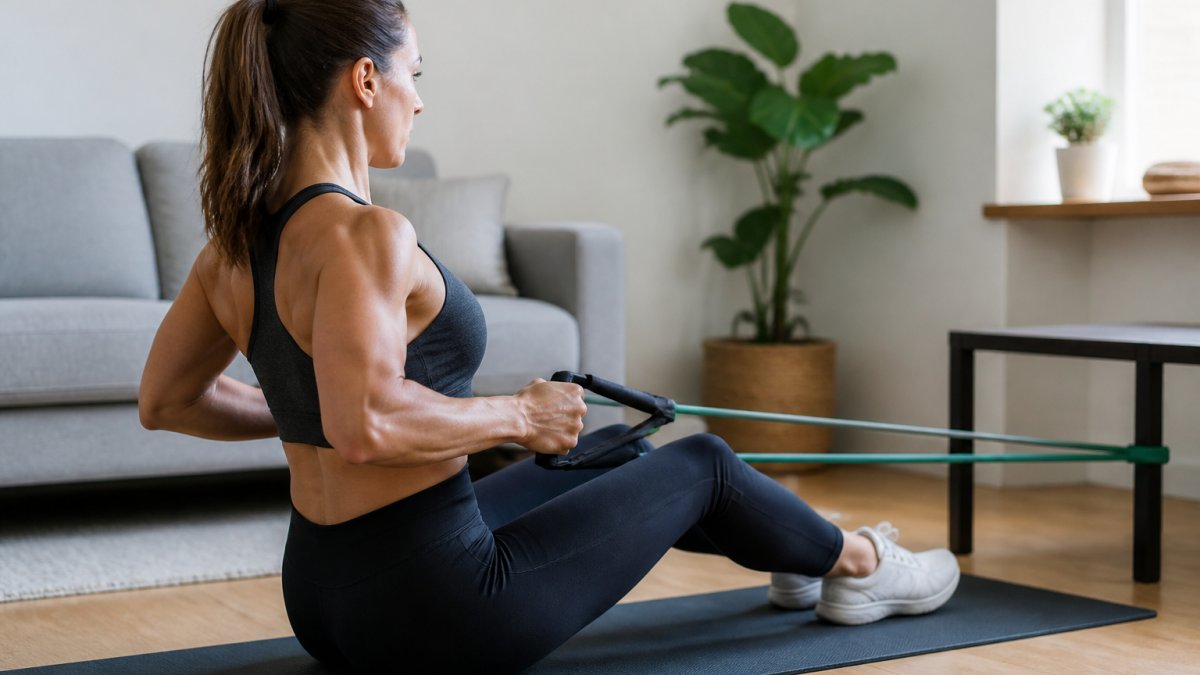
The best exercises focus on the muscles that hold your spine upright: your middle back, lower back, and the deep stabilizers along your spine. These muscles are often weak from sitting and hunching forward.
Resistance band rows are one of the most effective exercises for postural strength. They target your rhomboids and middle trapezius, the exact muscles that pull your shoulders back and hold good posture.
How to do it:
- Anchor a resistance band at chest height
- Stand facing the anchor point, feet shoulder-width apart
- Pull the band toward your chest, squeezing your shoulder blades together
- Hold for 2 seconds, then slowly release
- Do 3 sets of 12-15 reps
Reverse flyes activate your rear shoulders and upper back. They're especially important if you spend hours at a desk.
How to do it:
- Hold light dumbbells (5-10 pounds) with arms at your sides
- Bend slightly at the elbows and hinge forward from the hips
- Raise the dumbbells out to your sides until your arms are parallel to the ground
- Squeeze your shoulder blades together at the top
- Lower slowly and repeat
- Do 3 sets of 12 reps
Plank variations build core stability, which supports your lower back and helps you maintain upright posture.
How to do it:
- Start in a forearm plank position
- Keep your body in a straight line from head to heels
- Engage your core and glutes
- Hold for 30-60 seconds
- Rest and repeat for 3 sets
Prone Y-T-W raises target your shoulder stability and upper back.
Women's Anti-Hunchback Posture Correction Sports Bra with Chest Pad →
How to do it:
- Lie face down on a bench or the floor
- Raise your arms in a "Y" shape, hold for 2 seconds
- Lower and raise in a "T" shape, hold for 2 seconds
- Lower and raise in a "W" shape, hold for 2 seconds
- This is one rep. Do 8-10 reps per set, 3 sets total
Progressive Routine: Building Strength Alongside Support
The goal is to gradually increase strength while reducing your dependence on the corrector. This routine takes 4-6 weeks to see noticeable results.
Weeks 1-2: Foundation building
- 3 days per week, 15-20 minutes per session
- Perform resistance band rows, 3 sets of 12 reps
- Perform reverse flyes, 3 sets of 10 reps
- Hold planks for 30 seconds, 3 sets
- Wear corrector 2-3 hours daily during desk work
Weeks 3-4: Adding intensity
- 3-4 days per week, 20-25 minutes per session
- Add weight to your exercises (light dumbbells or heavier resistance bands)
- Increase plank hold to 45-60 seconds
- Add prone Y-T-W raises, 3 sets of 8 reps
- Wear corrector 3-4 hours daily, primarily during focused work
Weeks 5-6: Building independence
- 4 days per week, 25-30 minutes per session
- Increase weights or resistance further
- Add single-arm rows to challenge stability
- Increase plank variations (side planks, plank with leg lifts)
- Reduce corrector wear to 2-3 hours daily, only when needed
Track your progress. Can you hold a plank longer? Are your rows getting stronger? These are signs that your postural muscles are rebuilding. As strength improves, you'll naturally rely less on the brace.
How to Improve Posture Without a Brace
A corrector is temporary. Real posture improvement comes from awareness, strength, and habit. You can build better posture without ever wearing a brace.
Develop postural awareness. Most people have terrible posture because they don't notice it. Set phone reminders every hour to check your alignment. Are your shoulders rounded forward? Is your chin jutting out? Awareness is the first step.
Fix your workspace. Your desk, chair, and monitor position directly affect your posture. Your monitor should be at eye level. Your elbows should bend at 90 degrees when your hands rest on the keyboard. Your feet should be flat on the floor. Spending 8 hours in a bad position undoes hours of corrector wear.
Stretch your chest and front shoulders. Most people are tight in the front of their body and weak in the back. Doorway stretches, wall angels, and chest stretches help open up the front and allow better posture.
A simple doorway stretch:
- Stand in a doorway with your arm raised to 90 degrees
- Step through the doorway, feeling a stretch across your chest
- Hold for 30 seconds, repeat 3 times per side
Build a daily movement habit. Sitting for hours collapses your posture. Stand up every 30 minutes. Walk. Move your spine in all directions. Movement is medicine for posture.
Strengthen your core. Your core muscles support your spine and help you maintain upright posture. Planks, dead bugs, and bird dogs are simple exercises that build core strength.
Using a Posture Corrector as a Tool, Not a Crutch
The distinction between using a corrector wisely and becoming dependent on it is simple: intentionality.
A tool is something you use to accomplish a specific goal, then put down. A crutch is something you lean on because you've lost the ability to stand on your own.
A posture corrector should be a tool. You wear it during specific activities (desk work, standing meetings) while you rebuild strength and awareness.
This requires a clear plan. Know why you're wearing it. Know when you'll wear it. Know what exercises you're doing to build strength. Know when you'll reduce wearing time.
Many people use a corrector as a crutch. They wear it all day, every day, without doing any strengthening work. Their muscles never rebuild. When they take off the brace, their posture collapses. This cycle repeats.
The difference is effort. A tool requires you to do the work. A crutch lets you avoid it.
If you're using a posture corrector, commit to the strengthening routine. The brace is the training wheels. Your muscles are what will eventually hold your posture upright.
Better Living Mosaic offers the Women's Anti-Hunchback Posture Correction Sports Bra with Chest Pad, designed with integrated posture correction technology to encourage proper spinal alignment and shoulder positioning.

The corrector provides the external cue. Your exercises build the internal strength. Together, they create lasting change.
The real question isn't whether a posture corrector weakens your muscles. It's whether you're willing to do the work to strengthen them. A corrector is most effective when used as a temporary training tool paired with consistent exercise.
Frequently Asked Questions
Can wearing a posture corrector all day weaken your muscles?
Prolonged, all-day reliance on a posture corrector can reduce the demand on your postural muscles, potentially leading to decreased muscle engagement over time. However, this happens only with continuous, uninterrupted use without active strengthening. Short-term wear (2-4 hours daily) combined with targeted exercises prevents this risk. The key is treating the corrector as a temporary alignment cue, not a permanent substitute for active posture control.
How long is too long to wear a posture corrector?
Most experts recommend limiting posture corrector wear to 2-4 hours daily, gradually reducing frequency as your awareness and strength improve. Wearing one for 8+ hours continuously risks reducing muscle activation in your back and shoulder stabilizers. Start with shorter sessions (30-60 minutes) and increase duration only if you're simultaneously doing strengthening exercises. Never wear a corrector overnight or for entire workdays without breaks.
What exercises help strengthen back muscles for better posture?
Effective exercises include rows (resistance band or dumbbell), reverse flyes, superman holds, and scapular retractions. These target the rhomboids, latissimus dorsi, and posterior deltoids, the muscles responsible for holding your shoulders back and spine upright. Perform these 3-4 times weekly for 8-12 reps per exercise. Combine strength training with posture awareness work (like brief corrector use) to build independent muscle control without relying on external support.
Is it safe to exercise while wearing a posture corrector?
Light activity and daily movement while wearing a corrector are fine, but intense exercise is not recommended. High-impact workouts or heavy lifting with a corrector on can restrict natural movement patterns and reduce the engagement of stabilizer muscles you're trying to strengthen. Remove the corrector during exercise sessions, then perform your workout to build authentic postural strength. This ensures your muscles work independently rather than becoming dependent on external support.