

Table of Contents
- Why Most Ingredient Lists Are Misleading (And How to Fix That)
- How to Read Skincare Labels Like a Dermatologist
- Active vs Inactive Ingredients in Skincare: What Actually Works
- Understanding Skincare Ingredient Concentration Levels
- Spotting Marketing Fluff vs. Proven Active Ingredients
- How to Identify Effective Skincare Ingredients That Work Together
- Your Step-by-Step Ingredient Evaluation Checklist
- Conclusion: Build a Routine Around Evidence, Not Hype
- Frequently Asked Questions
Last Updated: September 9, 2026
Why Most Ingredient Lists Are Misleading (And How to Fix That)
The average skincare label reads like a chemistry exam, and most shoppers recognize one or two names and put the bottle back. Ingredient lists are ordered by concentration, but they tell you almost nothing about whether a formula will perform. Identifying effective skincare ingredients requires a framework, not a dictionary.
Marketing language and clinical efficacy rarely overlap on the front of a package. Words like "natural," "clinical strength," and "dermatologist-tested" are not regulated claims in most cases, while the actual evidence sits in the fine print on the back.
Below, we'll walk through the exact process dermatologists use to scan a label, explain why concentration matters more than ingredient count, and give you a checklist you can apply to anything in your bathroom cabinet.
How to Read Skincare Labels Like a Dermatologist
A dermatologist reads an ingredient list from the bottom up. The first five ingredients typically make up 80% of the formula and are almost always water, emollients, and preservatives, while the compounds that drive results usually appear further down at concentrations between 0.1% and 5%.
The FDA requires ingredients to be listed in descending order of concentration, so anything listed after the preservatives (usually phenoxyethanol or parabens) is present at less than 1%. If a product claims to contain hyaluronic acid but lists it after the preservatives, the concentration is likely too low to deliver meaningful hydration.
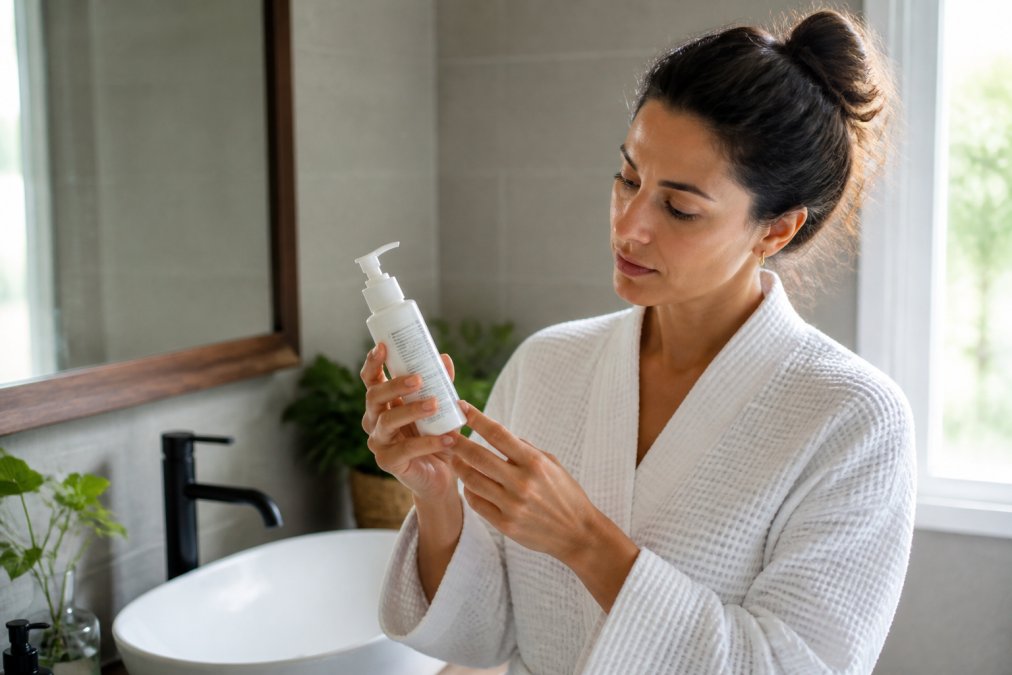
Look for the percentage disclosure, which many reputable brands now print directly on the label. According to FDA labeling requirements for cosmetics, concentration disclosures are voluntary, so their absence is a red flag. When a brand states "2% salicylic acid" or "10% glycolic acid" on the front, it signals transparency about the formula's actual potency.
Active vs Inactive Ingredients in Skincare: What Actually Works
Active ingredients are the compounds that produce a measurable biological change in the skin, such as retinoids for collagen production, salicylic acid for exfoliation, or niacinamide for barrier repair. Inactive ingredients are the delivery system: water, oils, emulsifiers, and preservatives that keep the formula stable and spreadable.
A product can contain a clinically proven active ingredient and still fail if the delivery system prevents dermal absorption. Vitamin C is notoriously unstable and degrades quickly when exposed to light and air, so a formula that lists ascorbic acid high on the label may still be useless in a clear glass jar rather than an airless pump.
A common mistake is assuming more active ingredients equal better results. Layering multiple exfoliating acids or combining retinol with direct acids in the same routine can strip the lipid barrier and cause irritation, redness, and peeling. The smarter approach is to rotate actives across your morning and evening routines.
| Ingredient Category | Primary Function | Common Examples | Best For |
|---|---|---|---|
| Retinoids | Collagen production, cell turnover | Retinol, retinaldehyde | Fine lines, texture |
| Exfoliating Acids | Surface cell removal | Glycolic acid (AHA), salicylic acid (BHA) | Dullness, congestion |
| Hydrators | Moisture retention | Hyaluronic acid, glycerin | Dryness, dehydration |
| Barrier Support | Lipid repair, calming | Ceramides, niacinamide | Sensitivity, redness |
Understanding Skincare Ingredient Concentration Levels
Concentration is the single most important factor in determining whether an active ingredient will work or cause harm, yet most labels hide this information. Effective skincare ingredients like retinol produce results at concentrations as low as 0.1%, while glycolic acid needs at least 5% to meaningfully exfoliate.
The challenge is that brands rarely disclose percentages, leaving you to estimate based on the ingredient's position in the list. A practical rule of thumb: if a clinically validated active appears after the preservatives, treat the claim with suspicion. The American Academy of Dermatology guidance on retinoids notes that even low-concentration retinoids require consistent use over several months to show visible improvement, which means a barely-there amount will likely disappoint.
Position alone is a blunt instrument. To judge a formula, you need to know the typical effective range for each active category and where the preservative line usually falls. Here is the working framework most formulators use:
| Ingredient Type | Typical Effective Range | Where It Usually Sits on the Label | What Sub-1% Means |
|---|---|---|---|
| Retinoids (retinol, retinaldehyde) | 0.1% - 1% | Middle to lower half | Likely ineffective for collagen stimulation; may still cause irritation |
| Vitamin C (L-ascorbic acid) | 5% - 20% | Upper third, before emulsifiers | Too low to meaningfully boost collagen or brighten |
| AHAs (glycolic, lactic) | 5% - 15% | Upper third | Below 5%, exfoliation is negligible |
| BHAs (salicylic acid) | 0.5% - 2% | Middle | At 0.5% it may help oil control but not deep pore clearance |
| Niacinamide | 2% - 10% | Middle | Below 2%, barrier support is minimal |
| Hyaluronic acid | 0.1% - 2% | Lower half (often near preservatives) | Can still be effective at 0.1%, this is the exception to the rule |
| Peptides | 0.01% - 5% | Bottom of the list | Position is not a reliable indicator; peptides work at trace levels |
When a brand does not disclose percentages, you have three practical ways to estimate potency:
- Find the preservative line. Preservatives like phenoxyethanol, sodium benzoate, or potassium sorbate are typically used at 0.5% - 1%. Anything listed after them is below 1%. If your target active sits after that line, it is almost certainly underdosed, unless it belongs to the peptide or hyaluronic acid category.
- Look for the 'other' ingredients. Glycerin, butylene glycol, and dimethicone are often used at 2% - 5%. If your active appears after these but before the preservatives, it is likely in the 1% - 2% range. That is enough for niacinamide or salicylic acid, but not for glycolic acid or vitamin C.
- Check the front of the package for a disclosure. More brands now print "10% glycolic acid" or "2% salicylic acid" on the front panel. This is voluntary under FDA rules, so its presence signals transparency. Its absence shifts the burden of proof onto the consumer.
Patch testing is non-negotiable when you're trying a new active ingredient. Apply a small amount to your inner forearm or behind your ear daily for five to seven days before using it on your face. This window is long enough to reveal delayed reactions, which are common with retinoids and exfoliating acids.
One more variable matters: pH. An acid can be present at the right concentration and still do nothing if the formula's pH is too high. Glycolic acid needs a pH below 4 to exfoliate effectively; above 4.5, it is essentially neutralized. Retinol works best in a pH range of 5.0 - 6.5. If a brand does not disclose pH, a simple pH test strip can verify it at home.
Spotting Marketing Fluff vs. Proven Active Ingredients
The cosmetics industry is built on aspirational language, and separating signal from noise requires asking one question: is this claim backed by peer-reviewed research on this specific molecule, or is it borrowed from a botanical extract with no clinical data?
Plant extracts and "natural" compounds are the most common culprits. While some, like green tea polyphenols and licorice root extract, have genuine antioxidant and brightening properties, many are added at trace levels purely for label appeal. The National Institutes of Health database on cosmetic ingredient research shows that the most extensively studied compounds tend to be synthetic or semi-synthetic molecules like retinoids, niacinamide, and stabilized vitamin C derivatives.
Preservatives are the most misunderstood category. Parabens, phenoxyethanol, and sodium benzoate are what keep your product from growing mold and bacteria. A formula without preservatives is a greater safety risk than one with them.
How to Identify Effective Skincare Ingredients That Work Together
Knowing which ingredients are effective in isolation is only half the battle. Ingredient interaction determines whether your routine builds on itself or works against your skin barrier. The real-world question is always: can I use this with what I already own?
Some combinations actively destroy each other. The most common problematic pairings break down like this:
Retinol + direct acids (AHAs/BHAs). Retinol converts to retinoic acid in the skin, which increases cell turnover and thins the stratum corneum. Direct acids also exfoliate the surface. Used together, they compound irritation and can cause peeling, redness, and a compromised moisture barrier. The exception is a single formulated product that contains both at low percentages with buffering agents.
Vitamin C (L-ascorbic acid) + benzoyl peroxide. Benzoyl peroxide generates free radicals that oxidize and degrade vitamin C before it can penetrate. The vitamin C becomes useless, and the combination can also produce transient yellow-brown staining on clothing and towels. If you use both, apply vitamin C in the morning and benzoyl peroxide on different evenings.
Vitamin C + retinol at the same time. Both are pH-sensitive. L-ascorbic acid works best at a pH below 3.5, while retinol is most stable around pH 5.5 - 6.5. Applied together, one will be working outside its optimal pH window, reducing efficacy for both. This is why the standard recommendation is vitamin C in the morning and retinol at night.
Copper peptides + vitamin C. Copper peptides are chelating agents that can bind to and destabilize L-ascorbic acid, causing both ingredients to degrade faster. If you use both, separate them by at least 30 minutes.
Niacinamide + direct acids (the myth). The old warning that niacinamide and vitamin C cannot be used together has been largely debunked at normal skincare pH levels. However, niacinamide can convert to niacin (which causes flushing) when combined with strong acids at low pH. In practice, most modern formulations buffer this effect.
A safe layering framework looks like this:
| Routine Slot | Safe Options | What to Avoid Pairing With |
|---|---|---|
| Morning | Vitamin C, hyaluronic acid, niacinamide, peptides | Benzoyl peroxide, direct acids |
| Evening | Retinol, ceramides, barrier creams | Direct acids on the same night as retinol |
| Exfoliation nights (1-2x/week) | AHA or BHA alone | Retinol, vitamin C, benzoyl peroxide |
| Recovery nights | Ceramides, glycerin, panthenol, peptides | All active exfoliants |
Some pairings genuinely amplify each other. Niacinamide and hyaluronic acid work well together because niacinamide supports the lipid barrier while hyaluronic acid draws moisture into the skin. Ceramides pair effectively with almost anything since they reinforce the skin barrier against irritation from other actives. Retinol and niacinamide are a strong evening combination, niacinamide at 2% - 5% has been shown to reduce retinol-induced irritation without interfering with its efficacy.
Sun protection factor is the one non-negotiable partner for any active ingredient. Retinoids and acids increase photosensitivity, meaning your skin burns more easily while you use them. Daily sunscreen application is not optional if you want the collagen production benefits to outweigh the UV damage risk.
Your Step-by-Step Ingredient Evaluation Checklist
Use this checklist whenever you're evaluating a new product. The goal is to make the process repeatable and quick.
- Check for percentage disclosure. Look for explicit concentration claims on the front or back label. Their absence warrants extra scrutiny.
- Locate the primary active ingredient. Find the compound that matches your skin concern, whether that's fine lines, hyperpigmentation, or congestion.
- Verify its position relative to preservatives. If the active appears after the preservatives, the concentration is likely below 1% and probably insufficient.
- Confirm the delivery system. Is the product in an opaque, airless pump or a clear jar? Light and oxygen degrade many actives, including vitamin C and retinoids.
- Check for supporting ingredients. Ceramides, niacinamide, and glycerin indicate a formula designed to maintain barrier health alongside the active.
- Scan for known irritants. Fragrance and essential oils are the most common causes of contact dermatitis, especially in leave-on products.
- Assess the pH level. Acids require a pH below 4 to exfoliate effectively. If the brand doesn't disclose pH, a simple pH test strip can verify it at home.
- Run a patch test for five to seven days. This is the only reliable way to know how your skin will react.
Conclusion: Build a Routine Around Evidence, Not Hype
The skincare industry thrives on confusion because confused consumers buy more products. The antidote is a simple commitment: evaluate every formula the same way, demand transparency on concentration and delivery, and let your skin's response over several weeks be the final judge.
At Better Living Mosaic, we apply this same scrutiny to everything we stock. Our curated selection of skincare essentials focuses on formulas with proven actives, like the DermaGlow™ Collagen Moisturizing Anti Aging Face Cream and Wrinkle Remover and Glimmer Goddess™ Organic Retinol Wrinkle Repair Face and Neck Cream that support skin barrier function. We also offer the FaceGlow™ Bio-Collagen Peel-Off Mask and GlowEnzyme™ Facial Scrub Gel for a comprehensive approach to skincare. Every product we carry is backed by a 30-day money-back guarantee and free worldwide shipping.


Shop Better Living Mosaic and build a routine around evidence, not marketing claims.
Frequently Asked Questions
How can you tell if a skin care product is going to be effective?
Check the ingredient list for proven active ingredients like retinoids, vitamin C, niacinamide, or hyaluronic acid positioned near the top of the list. Look for the concentration percentage if listed. Then confirm the product uses a stable formulation and proper packaging that protects ingredients from light and air. Patch test on your jawline for a week before applying to your full face to see how your skin reacts.
What is the 1% rule in skincare?
The 1% rule refers to the concentration threshold where certain active ingredients become effective. Ingredients listed above the 1% mark appear before preservatives in the INCI list, since preservatives are typically used at 1% or less. If a beneficial ingredient appears after a preservative, it is likely present at a concentration below 1%, which may be too low to deliver meaningful results.
How long does it take to see results from active ingredients?
Results depend on the ingredient and your skin's cell turnover cycle, which takes about 28 days. Hydrating ingredients like hyaluronic acid and glycerin can improve skin appearance within hours. Niacinamide typically shows visible improvements in 4 to 8 weeks. Retinoids require 8 to 12 weeks for noticeable changes in fine lines and texture. Consistency matters more than switching products frequently.
What is the difference between active and inactive ingredients in skincare?
Active ingredients are the components biologically proven to change your skin, such as retinol for collagen production, salicylic acid for exfoliation, and niacinamide for barrier support. Inactive ingredients serve as the base, including water, emulsifiers, preservatives, and fragrances. They stabilize the formula and help active ingredients absorb properly. A product with a great active ingredient but poor inactive ingredients may not deliver results.