

Table of Contents
- Plaque vs. Tartar: Why Timing Decides Everything
- The Best Oral Hygiene Routine for Plaque Buildup
- Ultrasonic Dental Cleaning at Home: What the Technology Can and Cannot Do
- Home Remedies for Plaque Control: What Helps and What Harms
- How Remineralization Fights Plaque Buildup Between Brushings
- When Plaque Buildup Needs a Dental Professional
- Frequently Asked Questions
Last Updated: September 14, 2026
Plaque vs. Tartar: Why Timing Decides Everything
Learning how to remove plaque buildup at home starts with one fact: plaque is soft, sticky, and removable; tartar is hard, bonded, and not. Plaque is a bacterial biofilm that forms within hours of brushing, while tartar (dental calculus) is plaque that has absorbed minerals from saliva and hardened onto the tooth surface.
You have roughly 24 to 48 hours before soft plaque begins to calcify. Once it does, no toothbrush, flosser, or rinse can take it off. This guide walks through safe steps for the soft-plaque window, plus what to do once buildup has already hardened.
American Dental Association guidance on plaque and tartar
The Best Oral Hygiene Routine for Plaque Buildup
The best oral hygiene routine for plaque buildup is a twice-daily sequence built around one principle: keep deposits soft and disrupted so they never reach the 24-to-48-hour window where they calcify. Brush first, clean between teeth second, rinse last.
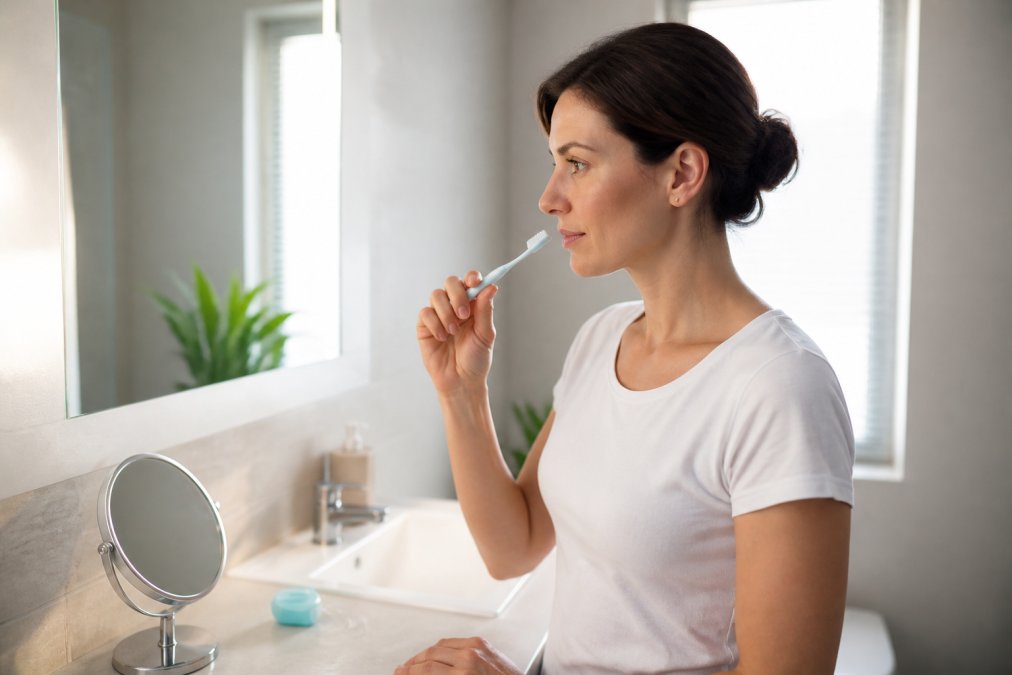
Most people brush for under a minute and skip between-teeth cleaning entirely, which is why buildup returns in the same spots. A workable daily structure looks like this:
- Morning: brush for two minutes with a soft-bristled toothbrush and fluoride toothpaste
- Evening: brush, then floss or use an interdental tool before you rinse
- Daily: drink water regularly to support saliva production, which buffers acids and clears debris
- Weekly: check your gumline in a mirror for new roughness or discoloration
The pH Window: Why Timing Beats Intensity
Every time you eat or drink something fermentable, oral bacteria produce acid that drops the pH at the tooth surface below roughly 5.5, the point at which enamel begins to dissolve. Saliva neutralizes that acid in about 20 to 30 minutes. Frequent snacking or sipping sugary drinks keeps the mouth acidic for hours, which is why grazing all day does more damage than a single dessert.
The takeaway: give your mouth recovery time between meals. Water rinses the mouth and speeds the return to a neutral pH, and chewing sugar-free gum stimulates saliva flow to do the same.
Brushing Technique That Actually Clears Bacterial Biofilm
Angling the brush at 45 degrees toward the gumline is the single technique change that clears the most bacterial biofilm. Short, gentle strokes along the gum margin reach where plaque accumulates fastest; scrubbing hard wears enamel and irritates gums.
Work in quadrants, spending about 30 seconds on each, with light pressure. Replace your brush every three to four months, or sooner if bristles splay. A powered brush with a timer and pressure sensor removes some of the guesswork.
Interdental Cleaning: Floss, Picks, and Water Flossers
Interdental cleaning removes plaque from the roughly one-third of each tooth surface a brush cannot touch. String floss remains the reference standard because it wraps and wipes the tooth curve; interdental brushes suit wider gaps, and water flossers help people who struggle with technique or wear braces.
The tool matters less than the habit: a water flosser used daily beats floss used twice a month. If dexterity is an issue, an interdental brush is often easier to use correctly.
Where Technology Fits Into the Routine
Manual tools have a blind spot: you cannot see what you are missing. The PlaqueVue™ Ultrasonic Dental Cleaning System with Live Camera addresses that by showing you where plaque is collecting along the gumline and between teeth, so you clean the spots you were actually missing. It slots into the routine above as a precision aid rather than a replacement for brushing and flossing, targeting soft plaque and biofilm, not fully calcified tartar.

American Dental Association guidance on plaque and tartar
Ultrasonic Dental Cleaning at Home: What the Technology Can and Cannot Do
Ultrasonic dental cleaning at home uses high-frequency vibration to break up soft deposits and disturb bacterial biofilm on the tooth surface. Consumer devices with a built-in camera let you see where plaque is collecting, so you clean the spots you were missing instead of guessing.
What it can do: loosen soft plaque, disrupt biofilm along the gumline, and improve your brushing accuracy when you can see the target. What it cannot do: chip away hardened tartar that has bonded to enamel. No consumer ultrasonic tool replaces professional scaling for calcified deposits.
The PlaqueVue™ Ultrasonic Dental Cleaning System with Live Camera is built around exactly this use case: the camera shows you the spots you were missing, so you clean where buildup actually sits. The one limitation: it targets soft plaque and biofilm, not fully calcified tartar.
Home Remedies for Plaque Control: What Helps and What Harms
Home remedies for plaque control range from genuinely useful to actively damaging, and the line is not obvious. The warnings come first here, because enamel erosion is permanent and the damage from a bad remedy outlasts any benefit.
What Actually Helps
Rinsing with an antimicrobial mouthwash, chewing sugar-free gum after meals, and swishing warm salt water are low-risk habits that support your routine. Oil pulling appears to reduce some surface bacteria but does not remove established deposits. None of these replace mechanical cleaning; they supplement it.
What Harms: The Abrasive and Acidic Trap
The harms matter more. Baking soda scrubbed hard, charcoal pastes, and acidic "whitening" mixtures can abrade or erode enamel, the mineral layer that never grows back. Once enamel erodes, the rougher surface collects plaque faster.
Enamel is the hardest tissue in the body, but it is not indestructible. Abrasive particles grind away mineral through friction; acids dissolve it through chemistry. Both thin a layer your body cannot regenerate, and once the mouth drops below roughly 5.5, enamel begins to dissolve.
Why Abrasive DIY Methods Damage Enamel
Abrasive DIY methods damage enamel because they grind away mineral while chasing a surface stain. Erosion is permanent, and a roughened, thinned surface holds onto plaque more stubbornly than a smooth one.
The trap is that these methods often look like they work: teeth feel slicker and look brighter for a few days because you removed surface film and a little enamel with it. Then roughness returns, plaque accumulates faster, and people escalate the remedy as the brightness fades, accelerating the damage.
A Safety-First Framework
Before trying any home remedy, run it through three questions:
- Does it rely on friction, grit, or acid to work? If yes, treat it as a risk to enamel rather than a cleaning tool.
- Does it have a pH below roughly 5.5? If yes, it can dissolve mineral on contact.
- Does it promise visible whitening in one session? If yes, it is likely removing surface enamel along with the stain.
Mechanical removal of soft plaque with a soft brush and interdental cleaning does the job without the trade-off. For more precision, the PlaqueVue™ Ultrasonic Dental Cleaning System with Live Camera lets you see where plaque is sitting so you clean the right spots without scrubbing harder, working on soft plaque and biofilm rather than hardened tartar.
CDC information on gum disease and oral health
How Remineralization Fights Plaque Buildup Between Brushings
Remineralization is the natural repair process in which calcium and phosphate from saliva are redeposited into enamel, hardening it against acid attack. Supporting that process between brushings is one of the most underused strategies in home oral care.
Fluoride toothpaste and mouthwash speed remineralization by helping minerals bind back into the enamel surface, which is why the type of toothpaste matters more than the brand. Ingredients that mirror enamel's mineral structure, such as nano-hydroxyapatite, are also used to support surface mineral content.
SmileGlow™ Teeth Brightening Serum is formulated with NH-10, a blend that includes nano-hydroxyapatite alongside hydrated silica, xylitol, and zinc gluconate.

When Plaque Buildup Needs a Dental Professional
Book a visit if you notice:
Persistent bad breath that doesn’t improve with brushing
Gums that bleed when you brush or floss
Red, swollen, or tender gums
Visible tartar (hard, yellowish deposits) that brushing can’t remove
Teeth that feel loose or gums that appear to be pulling away from teeth
CDC information on gum disease and oral health
Frequently Asked Questions
Can I remove hardened plaque myself?
No. Once plaque calcifies into tartar, it bonds to enamel like concrete and cannot be brushed, flossed, or scraped away safely at home. Only a dental professional has the instruments to remove it above and below the gumline without scratching enamel. What you can do at home is stop new plaque from hardening in the first place, which takes roughly 24 to 72 hours, by brushing twice daily and cleaning between teeth every day.
What dissolves plaque naturally?
Nothing dissolves plaque completely, but a few habits slow it down. Rinsing with oil pulling or an alcohol-free mouthwash can reduce bacterial biofilm on soft tissue and reach spots your brush misses. Chewing sugar-free gum with xylitol boosts saliva production, which neutralizes acids and rinses away food particles. These support your routine; they do not replace mechanical removal with a soft-bristled toothbrush and fluoride toothpaste.
How often should you remove plaque at home?
Plaque starts reforming within hours of brushing, so daily removal is the goal rather than a weekly deep clean. Brush for two minutes twice a day, and clean between teeth once daily with floss, interdental brushes, or a water flosser. If you wear braces or have gum disease, your dentist may suggest cleaning after every meal. Consistent daily plaque removal matters more than occasional intense sessions.
Is it safe to use tools to remove plaque at home?
Dental scalers and picks sold online are risky. Enamel is softer than the metal tips, so scraping can leave scratches that trap more bacteria and cause sensitivity. Sharp instruments also cut gums, raising infection risk. A safer option is an ultrasonic dental cleaning device designed for consumer use, paired with a soft-bristled toothbrush and fluoride toothpaste. Leave subgingival and supragingival scaling to a licensed dental professional.