

Table of Contents
- Why Most Wellness Product Claims Fall Apart Under Scrutiny
- Step 1: Check the Product Classification and Labeling Requirements
- Step 2: Understand the Difference Between Structure/Function Claims and Disease Claims
- Step 3: Look for Third-Party Supplement Testing Certification
- Step 4: Evaluate the Clinical Evidence Behind the Ingredients
- Step 5: Apply FTC Health Product Compliance Guidance to Marketing
- Step 6: Scan for Red Flags in the Fine Print
- Step 7: Use Ingredient-Level Verification Tools
- Frequently Asked Questions
Last Updated: September 8, 2026
Every day, shoppers scroll past dozens of wellness products promising thicker hair, smoother skin, and better sleep. Many of these claims dissolve the moment you read the fine print. Learning how to verify wellness product claims protects both your wallet and your health, and this guide from Better Living Mosaic walks you through a seven-step screening process you can apply to any product.
Regulatory oversight of supplements and cosmetics relies heavily on the manufacturer's own honesty. The Food and Drug Administration (FDA) does not approve dietary supplements for safety or effectiveness before they reach the market, placing the burden of scrutiny on you. Below are checks that can help separate products with real substance from those riding on marketing hype. Most guides get this wrong: they focus on a single label element, when the real answer lives in the interaction between classification, wording, evidence, and testing.
Why Most Wellness Product Claims Fall Apart Under Scrutiny
Most wellness product claims fail because they blur the line between what a product can legally say and what the manufacturer implies. A label might claim a cream "reduces the appearance of fine lines," which is a cosmetic statement, while the advertisement suggests it "reverses aging at the cellular level," which crosses into unapproved drug territory.
When a claim is vague, untestable, or relies on emotional language rather than mechanism, it usually signals that the manufacturer lacks the evidence to make a stronger statement. Products built on genuine science tend to make narrow, verifiable claims because they can back them up.
Consumer protection is not a single law but a patchwork. The FDA oversees product labeling and safety, while the Federal Trade Commission (FTC) polices advertising and marketing substantiation. Understanding this division is the first step toward spotting inflated promises, because a product can be technically legal on the label yet still mislead you in its advertising.
Step 1: Check the Product Classification and Labeling Requirements
Product classification determines which rules apply, and those rules dictate what a manufacturer is allowed to claim. A product is classified based on its intended use, which is communicated through the label, marketing, and even the product's name.
Cosmetics are defined as articles intended to be rubbed, poured, sprinkled, or sprayed on the body for cleansing, beautifying, or promoting attractiveness. Dietary supplements are products taken by mouth that contain dietary ingredients intended to supplement the diet. Drugs are articles intended to diagnose, cure, mitigate, treat, or prevent disease.
Each category carries its own labeling requirements. Cosmetics must list ingredients and net quantity, but they do not require pre-market approval. Supplements must include a Supplement Facts panel, a list of ingredients, and the manufacturer's contact information. Drugs require rigorous pre-market approval demonstrating safety and effectiveness.
| Classification | Intended Use | Key Label Element | Pre-Market Approval Required? |
|---|---|---|---|
| Cosmetic | Beautify or cleanse | Ingredient list | No |
| Dietary Supplement | Supplement the diet | Supplement Facts panel | No |
| Drug | Treat or prevent disease | Drug Facts panel | Yes |
If a product is marketed as a cosmetic but uses drug language like "treats" or "cures," it is misbranded. That mismatch is your first red flag, and it is a clear signal that the manufacturer is not operating within regulatory compliance.
Step 2: Understand the Difference Between Structure/Function Claims and Disease Claims
The wording on a label is the most telling evidence of a product's legitimacy. Manufacturers are legally permitted to make structure/function claims, which describe how a product affects the normal structure or function of the human body. An example is "calcium builds strong bones" or "fiber maintains bowel regularity."
These claims do not require pre-approval, but the manufacturer must have substantiation on file and include a disclaimer stating the product has not been evaluated by the FDA. The disclaimer is a legal requirement, not an admission of failure.
Disease claims, by contrast, assert that a product can diagnose, mitigate, treat, cure, or prevent a specific disease. A claim like "lowers cholesterol" or "reduces joint pain associated with arthritis" is a disease claim, and it requires the product to be regulated as a drug. If a supplement makes a disease claim without FDA approval, it is illegal.
Here is the practical test: if a product promises to fix a diagnosable condition, it is making a disease claim. If it describes supporting normal function, it is making a structure/function claim. The former requires clinical trials; the latter requires only reasonable substantiation. When a manufacturer blurs this line, they are violating FDA labeling requirements for dietary supplements, and you should treat every other claim on the bottle with suspicion.
Step 3: Look for Third-Party Supplement Testing Certification
A manufacturer can claim anything about their own quality controls, which is why independent verification matters. Third-party testing certification means an outside laboratory has verified that the product contains what the label says, in the stated amounts, without harmful contaminants.
The most recognized certification programs include NSF International, USP, and Informed Choice. These organizations audit manufacturing facilities, test finished products, and verify that the supplement actually contains its declared ingredients. A product bearing one of these seals has passed standardized testing that goes far beyond what the FDA requires for supplements.
When you cannot find a certification seal, look for a Certificate of Analysis (CoA). A reputable manufacturer will provide one upon request, often through a QR code on the label or a link on their website. The CoA should list the tested levels of active ingredients and the absence of heavy metals, pesticides, and microbial contaminants.
Third-party verification is one of the strongest signals of quality because it costs the manufacturer money and requires outside scrutiny. A company that invests in this transparency is less likely to cut corners on ingredient quality. The absence of third-party testing is not proof of a problem, but it is a gap in the evidence you should ask about.
Step 4: Evaluate the Clinical Evidence Behind the Ingredients
A bold claim on the front of a bottle means little without clinical evidence to support it. The key is to evaluate the evidence for the specific ingredients, not the finished product. Many products combine multiple ingredients, each with a different level of scientific support.
Start by identifying the active ingredients and their dosages from the Supplement Facts panel. Then search for peer-reviewed research on those specific ingredients at those specific doses. A common mistake is assuming that an ingredient shown to work at 500 mg will work at 50 mg. Dosage matters, and underdosing is a frequent tactic used to keep costs low while still listing a recognizable ingredient.
When evaluating studies, consider the source. Research published in peer-reviewed journals carries more weight than a manufacturer's own white paper. Look for studies conducted on humans rather than only on animals or in petri dishes, and note whether the results have been replicated by independent research groups. The National Institutes of Health Office of Dietary Supplements maintains fact sheets summarizing the current evidence for many common ingredients, which is a reliable starting point.
A product with genuine scientific backing will have studies showing meaningful results. The effect does not need to be dramatic, but it should be measurable and consistent across multiple trials. If the only evidence comes from the manufacturer's website or unverifiable testimonials, the claim rests on marketing rather than science.
Step 5: Apply FTC Health Product Compliance Guidance to Marketing
The label is only half the story. The advertising, social media posts, and even the product reviews that a brand amplifies all fall under the jurisdiction of the FTC, which enforces truth in advertising.
The FTC requires that all product claims be substantiated by competent and reliable scientific evidence, which for health products generally means well-controlled human clinical trials. A brand cannot make a claim in an Instagram caption that it would not be allowed to make on the label, nor use testimonials to imply effectiveness the science does not support.
The FTC has pursued enforcement actions against companies that used fake news sites, undisclosed paid endorsements, and misleading before-and-after photos to market their products. These actions serve as a reminder that marketing substantiation is not optional. When a brand makes bold claims in advertising but offers only anecdotal support, they are operating outside of FTC guidance on health product claims.
Evaluate marketing with the same skepticism you apply to the label. If an advertisement relies on emotional storytelling rather than specific, verifiable outcomes, it is designed to persuade, not inform. Trustworthy brands make marketing claims consistent with the evidence and the label.
Step 6: Scan for Red Flags in the Fine Print
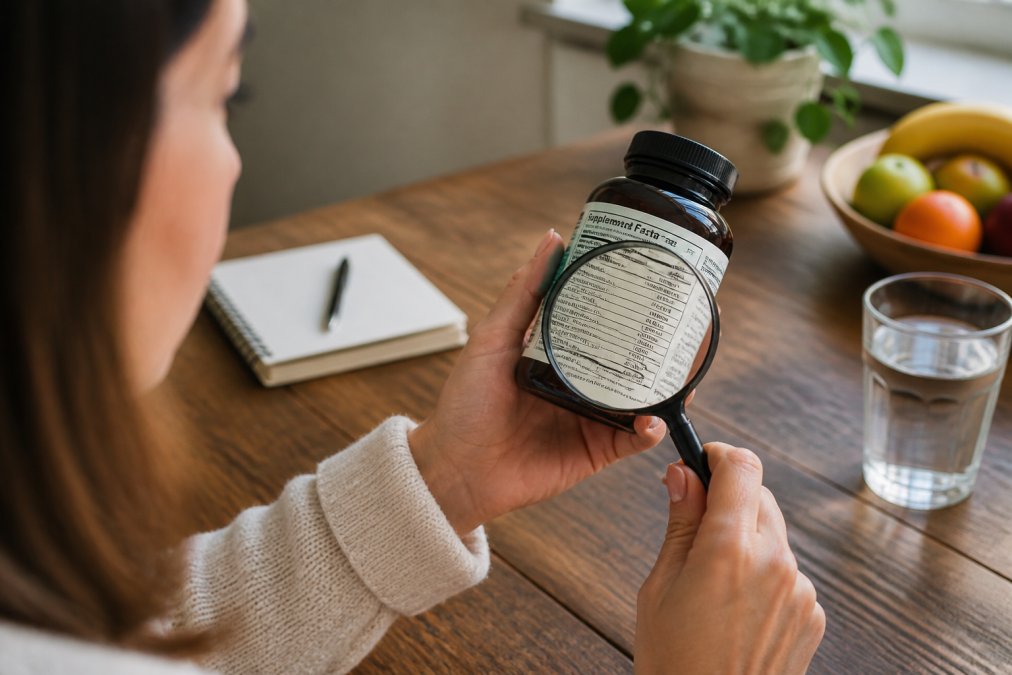
The fine print reveals what the marketing tries to hide. Certain phrases and patterns should immediately raise your suspicion, because they are common tactics used to obscure weak evidence or shift responsibility.
Beware of proprietary blends that list a combined weight without individual ingredient dosages. This practice makes it impossible to evaluate whether any single ingredient is present at an effective level. Watch for the disclaimer that appears in tiny type, which often admits that results are not typical or that the product is not intended to diagnose or treat any condition. While that disclaimer is legally required for supplements, its placement and prominence can tell you whether the manufacturer is being transparent or evasive.
Red Flag Checklist for Quick Screening
- Does the product make a disease claim without FDA approval?
- Are active ingredients hidden inside a proprietary blend without individual dosages?
- Is there a third-party certification seal or a verifiable Certificate of Analysis?
- Do the clinical studies cited involve humans, at the stated dosage, with replicated results?
- Does the marketing language match the claims on the label?
- Are customer testimonials presented as typical results rather than individual experiences?
- Does the product promise dramatic results in an unrealistically short timeframe?
If you answer yes to any of the first three questions, the product is likely relying on hype rather than substance. If you answer yes to the last question, you are looking at marketing fiction. Genuine health improvements take time, and any product promising overnight transformation is not operating on scientific principles.
Step 7: Use Ingredient-Level Verification Tools
Digital tools now put a significant amount of verification power in your hands. Instead of relying on a brand's self-description, you can cross-reference ingredients and claims against independent databases built on peer-reviewed research.
The most authoritative resource is the National Library of Medicine's PubChem database, which provides detailed chemical and safety information for virtually every compound found in supplements and cosmetics. For supplement ingredients specifically, the NIH Office of Dietary Supplements fact sheets summarize the current state of evidence, including known interactions and safety concerns.
Consumer-focused tools can also help. The Environmental Working Group's Skin Deep database rates cosmetics and personal care products based on the safety of their ingredients, while the supplement database from ConsumerLab.com provides independent test results and quality ratings. These tools are not perfect, but they offer an unbiased perspective that balances the manufacturer's marketing.
A practical workflow is to check the ingredient list against these databases before you buy. Look up each active ingredient, note its established uses and evidence level, and flag any ingredient with safety concerns or a weak evidence base. This process takes about ten minutes for a typical product, and it transforms you from a passive shopper into an informed evaluator.
The same principles that guide our curation at Better Living Mosaic apply to every product we stock: clear labeling, honest structure/function language, verifiable third-party testing, and ingredients with genuine clinical support. Our Hair Growth Accelerator, for example, is formulated with ingredients that have published research behind them, and we offer a 30-day money-back guarantee.

Verifying wellness product claims takes practice, but the checklist above gives you a repeatable system. Start with the classification, read the claim language carefully, demand third-party testing, and check the evidence at the ingredient level. When a product survives that scrutiny, you can buy with confidence. At Better Living Mosaic, we apply a vetting process to every product we curate, so you can shop our collection knowing each item has been carefully selected.
Frequently Asked Questions
How do you verify third-party testing on supplements?
Look for a certification seal from an independent organization like NSF International, USP, or ConsumerLab. Then go to that organization's website and search for the specific product name to confirm its certification is current. Many brands also publish Certificates of Analysis (COAs) from accredited labs; a COA should show the product's ingredient amounts and contaminant levels. If you cannot find the product in the certifier's database, the seal may be unverified or expired.
What are the red flags of misleading wellness product marketing?
Watch for language that promises a cure or treatment for a disease, such as 'cures arthritis' or 'eliminates tumors,' since those require FDA approval as a drug. Other red flags include vague ingredient lists, no Supplement Facts panel, claims that sound too good to be true, and pressure to buy immediately. Products that rely on anonymous testimonials instead of published studies also deserve extra scrutiny. When in doubt, run the label claims past the red flag checklist in this guide.
Does the FDA regulate wellness products the same way as prescription drugs?
No. Prescription drugs must be proven safe and effective before they reach the market. Dietary supplements and cosmetics do not need pre-market approval. The FDA steps in after a product is sold if it is unsafe or if the claims on its label make it an unapproved drug. That is why you need to verify wellness product claims yourself: the responsibility for safety and truthful labeling sits with the manufacturer, and enforcement happens after problems surface.