

Table of Contents
- What Counts as a Natural Retinol Alternative?
- Bakuchiol Benefits for Sensitive Skin
- Rosehip Oil and Other Botanicals That Mimic Vitamin A
- Ingredient Synergy: Pairing Alternatives for Better Results
- Signs of Retinol Irritation and Ingredients to Avoid
- Building a Skincare Routine for Sensitive Skin
- Frequently Asked Questions
Last Updated: September 16, 2026
What Counts as a Natural Retinol Alternative?
Natural retinol alternatives are plant-derived ingredients that support skin renewal without the irritation profile of synthetic retinoids. The most studied option is bakuchiol, a compound extracted from the seeds of the babchi plant, which has become the benchmark for natural retinol alternatives in sensitive skin routines.
The appeal is straightforward. Retinol, or trans-retinoic acid in its active form, accelerates cell turnover and supports collagen production, but it does so aggressively. Sensitive skin often responds with redness, flaking, and a compromised skin barrier.

How These Ingredients Differ From Synthetic Retinoids
Synthetic retinoids bind directly to retinoid receptors in the skin, which is why they work fast and why they irritate. Natural alternatives typically work through antioxidant properties and anti-inflammatory action instead. They support the dermal layer indirectly, encouraging epidermal renewal without the same receptor-driven shedding. The trade-off is speed: results take longer, but the irritation profile is far more forgiving.
Bakuchiol Benefits for Sensitive Skin
Bakuchiol is the closest thing to a direct retinol substitute in the botanical world. It supports collagen production and improves the look of fine lines and wrinkles while remaining non-comedogenic and generally well tolerated by reactive skin. For many people, it delivers visible firming and brightening without the peeling stage.
What the Research Actually Shows
Comparative studies have placed bakuchiol and retinol side by side on measures like wrinkle depth and hyperpigmentation, with bakuchiol showing meaningful improvement and notably fewer reports of stinging or scaling. The catch is that most trials are small and short. Bakuchiol has genuine scientific validation, but it sits a tier below retinol in terms of evidence volume. That matters if you want proof, not just a gentler feel.
Rosehip Oil and Other Botanicals That Mimic Vitamin A
Rosehip oil is the most common botanical cited for mimicking vitamin A, and the claim has a real basis. It contains small amounts of naturally occurring trans-retinoic acid along with linoleic and linolenic fatty acids that support the lipid barrier. That combination is why it feels nourishing rather than stripping. It suits dry, sensitive skin that wants moisturizer-level comfort with mild renewal, and it is one of the few botanicals where the vitamin A content is measurable rather than implied.
Rating the Evidence Behind Each Botanical
Most guides present these ingredients as interchangeable. They are not. The strength of the science varies widely, and knowing which tier an ingredient sits in helps you set realistic expectations instead of blaming your skin when nothing changes in two weeks.
| Ingredient | Mechanism | Evidence Tier | Best For |
|---|---|---|---|
| Bakuchiol | Supports collagen production; antioxidant and anti-inflammatory action | Moderate, small comparative trials against retinol | Fine lines, overall renewal |
| Rosehip oil | Naturally occurring trans-retinoic acid plus barrier-supporting fatty acids | Moderate for barrier support; limited for renewal | Dryness, mild texture |
| Sea buckthorn oil | Antioxidant and free radical defense; rich in omega fatty acids | Limited, mostly mechanistic and traditional use | Environmental stress, barrier comfort |
| Carrot seed oil | Antioxidant support; mild brightening | Anecdotal, little controlled data | Dullness in gentle routines |
| Gotu kola | Supports firmness and elasticity; traditional wound-healing use | Limited, small studies, mostly topical extracts | Firming, elasticity |
| Hydrolytic enzymes (papaya, pumpkin) | Dissolve dead surface cells without abrasion | Moderate for gentle exfoliation | Texture, congestion |
Ingredient Synergy: Pairing Alternatives for Better Results
The mistake most people make is treating these ingredients as substitutes to swap one-for-one. They work better as a system. Pair an antioxidant-rich botanical with a barrier-supporting oil, and you address two problems at once: photoaging and a weakened lipid barrier.
A workable pairing framework:
| Goal | Pair This | With This |
|---|---|---|
| Fine lines | Bakuchiol | Peptides |
| Dullness | Rosehip oil | Vitamin C |
| Dryness | Sea buckthorn oil | Ceramides |
| Texture | Hydrolytic enzymes | Niacinamide |
Signs of Retinol Irritation and Ingredients to Avoid
Retinol irritation shows up as persistent redness, stinging, flaking, and tightness that does not resolve with moisturizer. If your skin burns when you apply a product that used to feel fine, that is a barrier problem, not a purge.
If you are reactive, screen out these common triggers:
- Synthetic fragrance and essential oil blends
- Denatured alcohol high on the ingredient list
- Physical exfoliants with rough particles
- Strong acids used in the same routine as retinoids
- Preservatives like methylisothiazolinone
Building a Skincare Routine for Sensitive Skin
A skincare routine for sensitive skin should be short, consistent, and built around barrier support first. Every step earns its place. If a product stings, it comes out.
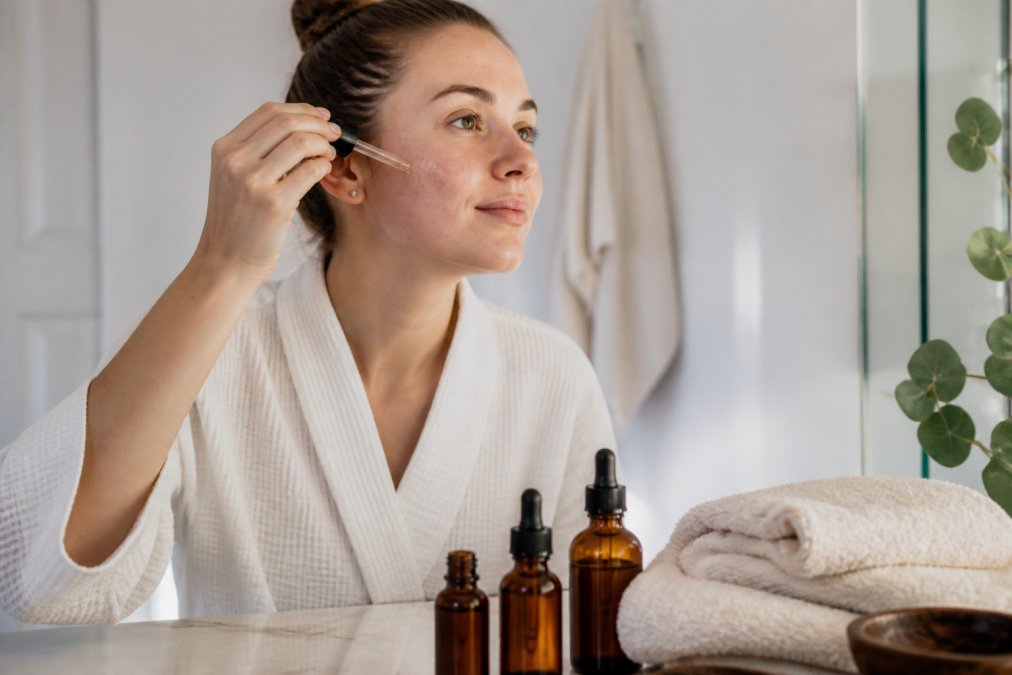
- Morning: Gentle cleanser, vitamin C serum, moisturizer, sunscreen
- Evening: Gentle cleanser, bakuchiol or rosehip oil, richer moisturizer
- Weekly: One mild enzyme exfoliation, no more
A Transition Protocol for Leaving Retinol Behind
Most guides tell you to stop retinol and start a botanical. That advice skips the hard part. Your skin has adapted to a faster turnover cycle, and cutting it abruptly can trigger a rebound of dullness, congestion, and a rough texture that makes people assume the natural alternative failed. It did not. The skin is recalibrating.
A transition protocol that works:
- Weeks 1-2: Reduce retinol to twice weekly, keep your moisturizer unchanged
- Weeks 3-4: Drop retinol to once weekly, introduce bakuchiol on two other nights
- Weeks 5-6: Stop retinol entirely, use bakuchiol every other night
- Week 7 onward: Move to nightly bakuchiol or rosehip oil based on how your skin feels
Choosing the Right Format for Reactive Skin
Format matters as much as the ingredient. A bakuchiol serum in a lightweight base absorbs quickly and suits oily or combination skin. An oil-based serum or a balm sits on top of the barrier and suits dry or reactive skin that needs occlusion. If your skin is both reactive and oily, a serum is usually the safer starting point because it carries fewer heavy emollients that can clog pores.
Troubleshooting the First Month
- Stinging that fades within minutes: usually a barrier that is still thin. Reduce frequency and add a ceramide moisturizer.
- Stinging that persists or worsens: stop the new product and return to cleanser, moisturizer, and sunscreen until the skin settles.
- New congestion around weeks three to four: often the turnover rebound, not the botanical. Give it another two weeks before changing anything.
- No visible change by week eight: the ingredient may simply be too mild for your goals. That is information, not failure.
For the firming side of anti-aging, the AH-8™ Face Firm Care Kit pairs a Hexapeptide-8 neck cream with an electric massage eye cream, targeting the eye and neck areas where loss of firmness tends to show first.

Frequently Asked Questions
What can I use instead of retinol for sensitive skin?
Bakuchiol, rosehip oil, and other botanical extracts are the most common swaps. Bakuchiol has a gentler irritation profile than synthetic retinoids while supporting collagen production and cell turnover. Rosehip oil supplies vitamin A precursors plus antioxidant properties that help with fine lines and hyperpigmentation. Many people layer these with barrier-supporting moisturizers so the skin stays calm while still working toward firmer texture and more even tone.
How do plant-based retinol alternatives differ from synthetic retinoids?
Synthetic retinoids like trans-retinoic acid bind directly to skin receptors and work fast, which is why they often cause peeling and redness. Plant-based options such as bakuchiol and rosehip oil support similar goals, cell turnover, collagen production, and brighter tone, through different pathways and at a slower pace. The trade-off is real: you give up speed for a gentler irritation profile, which matters if your skin barrier is already compromised or reactive.
How do I switch from retinol to a natural alternative without a reaction?
Stop retinol first and give your skin one to two weeks of plain barrier care: a gentle cleanser, a ceramide moisturizer, and sunscreen. Then introduce the alternative two or three nights a week, buffering with moisturizer if your skin feels tight. Add one extra night each week as tolerated. If redness or stinging returns, drop back a step. This transition protocol matters more than which ingredient you pick.
Can sensitive skin get anti-aging benefits without irritation?
Yes, but the pace is slower and the routine has to be consistent. Bakuchiol, rosehip oil, peptides, and vitamin C each support skin elasticity, fine lines, or brightening without the peeling that comes with trans-retinoic acid. The key is pairing them with a lipid barrier-friendly moisturizer and daily sunscreen, since photoaging undoes most of the progress you make. Expect visible change over eight to twelve weeks, not two.
What ingredients should I avoid if I have sensitive skin?
Skip synthetic fragrance, drying alcohols, and strong exfoliating acids used on the same night as your retinol alternative. Hydrolytic enzymes and gentle exfoliation are fine once a week, but layering them with an active increases the odds of a flare. Also avoid stacking vitamin C and bakuchiol in the same step; split them between morning and night so your skin barrier has room to recover.
Leaving retinol behind does not mean giving up on smoother, firmer-looking skin. It means choosing ingredients your barrier can actually tolerate long enough to see results. Better Living Mosaic curates skincare built around that idea, with a 30-day money-back guarantee and free worldwide shipping, and a catalog where each product is selected to solve a specific problem rather than fill a shelf. Start with the Beauty Bundle or the AH-8™ kit and build a routine your sensitive skin can keep.