

Last Updated: October 22, 2026
Quick Summary
Organic facial oils are plant-based products that enhance skin's natural glow by mimicking your skin's natural lipid structure, delivering hydration, nourishment, and antioxidants that support radiance. They work with your skin's biology to improve absorption, balance oil production, and strengthen your skin barrier over time.
- Organic oils create a protective seal that prevents transepidermal water loss, locking hydration in and supporting skin elasticity with consistent use.
- Essential fatty acids, vitamins E and A, and antioxidants in organic oils build healthier skin over 4-6 weeks of consistent application.
- Apply 2-3 drops to clean, slightly damp skin before moisturizer, using gentle upward strokes to allow full absorption.
- Start with once-daily application and patch test on your inner arm for 24 hours before committing to regular use.
Table of Contents
- Why Organic Facial Oils Deliver Radiance
- How Hydration and Moisture Retention Work
- Nourishment Through Lipids, Vitamins, and Antioxidants
- Strengthening Your Skin Barrier
- How to Use Face Oil in Your Skincare Routine
- Facial Oil Before or After Moisturizer: Layering Order
- Face Oil for Dry Skin and Skin-Type Selection
- How Often to Use Facial Oil and Safety Considerations
- Frequently Asked Questions
Why Organic Facial Oils Deliver Radiance
Organic facial oils are plant-based products that enhance skin's natural glow.

Organic facial oils work because they mimic your skin's natural lipid structure.
Many people think facial oils will make their skin greasy, but the right organic facial oils actually balance oil production.
Organic oils also deliver antioxidants and vitamins your skin can't make on its own, protecting against environmental stress and supporting natural repair for skin that looks fresher, smoother, and more radiant.
How Hydration and Moisture Retention Work
Deep hydration happens when your skin's outer layer absorbs and holds water. Organic facial oils don't add water directly; they create a seal that prevents moisture loss, known as transepidermal water loss (TEWL), the main reason skin becomes dry and dull.
When moisture escapes, fine lines become more visible and texture looks rough. Organic oils form a protective barrier that locks hydration in, letting your skin build up moisture reserves over time.
The lipids in organic oils are especially effective because they resemble the lipids naturally found in your skin, so they integrate smoothly into your barrier rather than sitting on top, keeping hydration locked in longer.
Better hydration also improves elasticity: plump skin bounces back more easily and looks firmer, which is why skin often looks more hydrated within days of a consistent routine.
Different oils offer different hydration benefits:
- Jojoba oil mimics skin's natural sebum closely
- Argan oil delivers both hydration and lightweight nourishment
- Rosehip oil combines hydration with vitamin A content
Nourishment Through Lipids, Vitamins, and Antioxidants
Organic facial oils contain essential fatty acids your skin needs but cannot produce on its own. These lipids are the building blocks of healthy skin cells; without them, the barrier weakens, leading to irritation, sensitivity, and visible aging.
Antioxidants in organic oils neutralize free radicals, unstable molecules that damage skin cells and accelerate aging. Sun exposure and pollution create them constantly, and antioxidants help protect against that ongoing damage.
The nourishment from organic oils builds over time. Consistent use leads to gradual improvements in texture, tone, and radiance; after 4-6 weeks, most people notice healthier, more luminous skin.
Strengthening Your Skin Barrier
Your skin barrier is the outer layer that protects everything beneath, keeping irritants out and moisture in.
Organic facial oils restore barrier function by replenishing the lipids that hold skin cells together.
A strengthened barrier reduces redness and irritation quickly, and over weeks your skin becomes more resilient to environmental stressors and irritating ingredients.
Signs your barrier needs support include:
- Tightness or rough texture
- Increased sensitivity to products
- Persistent redness or inflammation
When you support your barrier with organic oils, these issues improve noticeably.
How to Use Face Oil in Your Skincare Routine
Apply organic facial oils to clean, slightly damp skin, which lets oils penetrate more effectively. Pat your face until it's barely moist, not dripping wet.
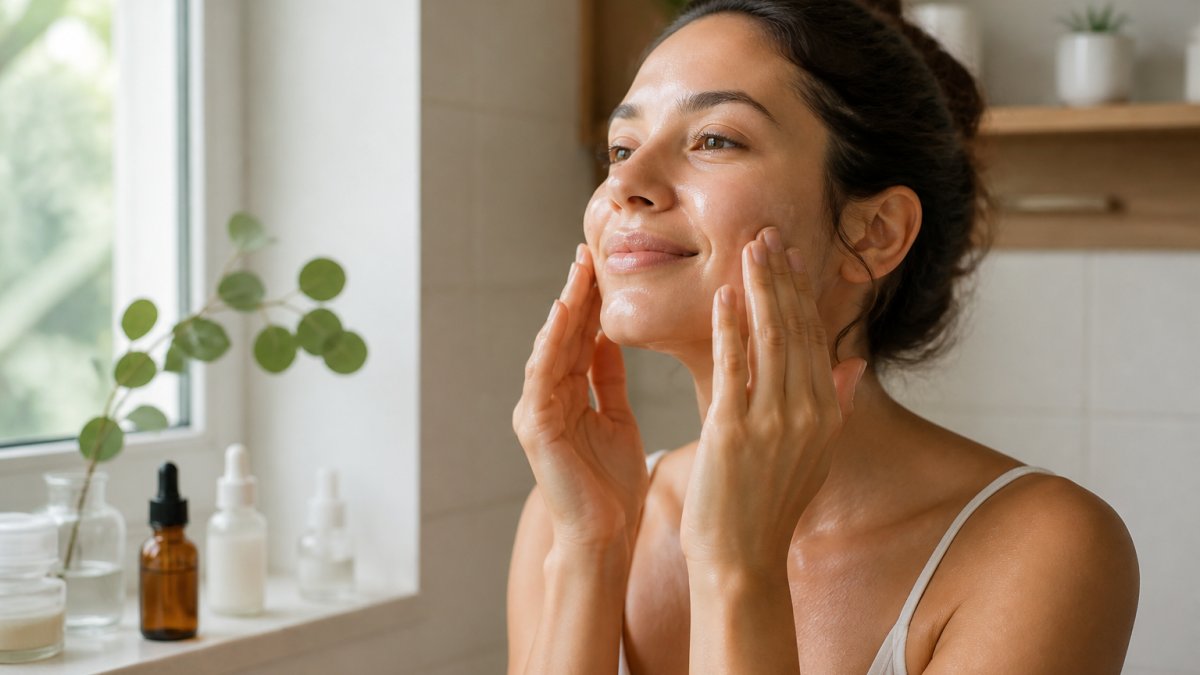
Dispense 2-3 drops into your palm and warm it between your hands. Press gently onto face, neck, and décolletage with upward strokes, avoiding tugging delicate under-eye skin.
The process takes about 30 seconds. Gentle application helps the oil absorb fully rather than sitting on the surface, and many people find the massage calming.
Your routine for using organic oils:
- Cleanse your face with a gentle cleanser
- Pat skin until just slightly damp
- Apply any water-based serums or treatments first
- Warm 2-3 drops of facial oil between your palms
- Press gently onto face, neck, and décolletage
- Wait 1-2 minutes before applying moisturizer
Facial Oil Before or After Moisturizer: Layering Order
How to use face oil depends on your skin type and product consistency.
For most people, the correct order is:
- Cleanser
- Toner or essence (if using)
- Serums and treatments
- Facial oil
- Moisturizer
- Sunscreen (morning only)
Applying oil before moisturizer lets it absorb first, then your moisturizer seals everything in, creating the best hydration and preventing products from sitting on the surface.
If your moisturizer is very lightweight, you can apply oil after it, but heavier creams should go last. Your moisturizer's thickness determines the best order.
Some people use oil as their only moisturizer, which works well for oily or combination skin.
Face Oil for Dry Skin and Skin-Type Selection
Face oil for dry skin is often the most effective solution because dry skin needs both hydration and occlusion. Dry skin lacks sufficient lipids, so organic oils address the root problem while trapping moisture. But "pick an oil for your skin type" leaves the real question unanswered: which oil, in what climate, at what weight? Use the framework below.
Start with your skin type
Skin type |
What the skin needs |
Oil weight to look for |
Oils that fit |
|---|---|---|---|
Dry |
Lipid replenishment plus occlusion |
Medium to rich |
Argan, jojoba, rosehip, marula |
Oily |
Light hydration without added heaviness |
Light, fast-absorbing |
Grapeseed, squalane |
Combination |
Different needs on different zones |
One light plus one medium |
Grapeseed on the T-zone, argan or rosehip on cheeks |
Sensitive |
Minimal ingredient load, low irritation risk |
Light to medium, fragrance-free |
Squalane, jojoba |
Dry skin benefits most from richer oils like argan, jojoba, and rosehip, which carry more fatty acids and vitamins and absorb more slowly. Oily skin does better with lighter oils like grapeseed or squalane, which absorb quickly without a greasy finish.
Sensitive skin needs careful selection: look for organic oils with short ingredient lists and no added fragrance or essential oils, and start with a single drop before building up.
Then adjust for climate and season
Skin type is only half the decision. The same person can need a different oil in July than in January.
- Humid climates and summer: lighter oils and fewer drops. Heavy oils can feel occlusive and contribute to congestion when humidity is already high.
- Dry climates and winter: richer oils and an extra drop. Cold, low-humidity air accelerates water loss, so barrier-supporting oils earn their place.
- Indoor heating and air conditioning: both dry the air. If your skin feels tight by mid-afternoon, that's a climate signal, not necessarily a product failure.
A practical pattern: keep one light oil (grapeseed or squalane) and one richer oil (argan or rosehip) on hand, and switch or blend based on how skin feels that week.
Judge by feel, not by label
The right oil absorbs within a few minutes and leaves skin comfortable, not tight and not slick. Tight an hour later means the oil is too light or you used too little; shiny at midday means it's too heavy or you used too much. Adjust one variable at a time, oil weight first, then amount.
How Often to Use Facial Oil and Safety Considerations
Use organic facial oils once or twice daily. Consistent use delivers the best results for hydration, nourishment, and radiance. If you're new to facial oils, start with once daily and add a second application after a week or two if your skin responds well.
Patch test before you commit
Apply a small amount to your inner arm or behind your ear and wait 24 hours, watching for irritation, redness, or itching. Discontinue immediately if you experience persistent redness or burning, itching or hives, swelling, or worsening breakouts.
Most skin adjusts within 2-4 weeks; if irritation continues beyond a week, the oil may not be right for you. Store oils in cool, dark places, since light and heat degrade the vitamins and antioxidants that make them effective.
What "organic" actually means on a label
In the United States, "organic" on a cosmetic label is not a single regulated guarantee. The U.S. Department of Agriculture (USDA) National Organic Program sets standards for agricultural ingredients, and the USDA Organic seal may appear on personal care products that meet those requirements. A product can also use "organic" in its marketing without the seal, as long as the claim isn't misleading, so the word alone tells you less than the certification behind it.
When you assess a product, look for:
- A certifying body named on the label or listing, the USDA seal is the clearest U.S. reference point for organic agricultural content.
- The ingredient list, not the front of the bottle. Organic claims often apply to a few hero ingredients while the formula still contains fragrance, preservatives, or carrier oils that aren't organic.
- Sourcing detail. Reputable brands state where key oils come from and how they're pressed or refined. Vague "pure and natural" language is a marketing signal, not a sourcing one.
Where radiance claims stop and evidence begins
It's worth separating two meanings of "glow." A temporary sheen from any oil is a surface effect that lasts until you wash your face. Longer-term changes in hydration and smoothness depend on consistent use over weeks, not a single application. No cosmetic oil is a treatment for a skin condition, and results vary by person, judge by how your own skin looks and feels over a month of steady use.
When to stop or check with a professional
Stop use and consult a dermatologist if you develop a spreading rash, swelling, or breakouts that don't settle after a couple of weeks.
Choose organic oils from sources that verify purity and disclose sourcing. If you'd like to try a plant-based, oil-based option, the Beauty Bundle from Better Living Mosaic includes the Phytotox Serum, backed by our 30-day money-back guarantee.
Frequently Asked Questions
Should you use facial oil every day?
Most skin types benefit from daily facial oil use, but frequency depends on your skin's needs. If you have dry or sensitive skin, daily application works well. For oily or combination skin, use facial oil 3-5 times per week or adjust based on how your skin responds. Start with fewer applications and increase gradually as your skin adapts. Watch for signs of balance—improved texture and hydration without excess shine indicate the right frequency for you.
What is the best organic facial oil for glowing skin?
The best organic facial oil for radiance depends on your skin type and concerns. The Beauty Bundle from Better Living Mosaic includes the Phytotox Serum, an oil-based formula packed with herbal ingredients. For deeper hydration, the Phytotox Tallow offers hydrating benefits. Patch test any new oil on a small area first to ensure compatibility with your skin.
Can facial oil make oily or acne-prone skin look greasy?
Facial oils can work for oily skin when applied correctly and in moderation. The key is using the right oil type and amount. Lighter oils absorb faster than heavier ones. Apply just a few drops to damp skin, press gently rather than massage, and use less frequently—3-5 times per week instead of daily. Some oils actually help balance oil production by signaling to your skin that it has enough moisture, reducing excess sebum. If greasiness occurs, reduce the amount or frequency, or switch to a lighter oil formula.
How can you tell whether an organic facial oil suits your skin?
Test any new facial oil with a patch test first: apply a small amount to your inner arm or behind your ear and wait 24 hours for signs of irritation. If no reaction occurs, try the oil on a small facial area for 3-5 days before full application. Monitor your skin for improved hydration, texture, and radiance without excess shine, redness, or breakouts. If your skin feels plumper, smoother, and looks more luminous within 2-3 weeks, the oil is a good match. If irritation, congestion, or excessive oiliness develops, discontinue use and try a different formula.