

Table of Contents
- Posture Corrector vs Ergonomic Chair: Key Differences
- Posture Corrector Benefits and Drawbacks
- Ergonomic Chair for Back Pain: What It Offers
- How Long to Wear a Posture Corrector Daily
- How to Sit Properly at a Desk
- Choosing Between Them: A Practical Framework
- Comparison Table
- Frequently Asked Questions
Last Updated: October 15, 2026
Posture Corrector vs Ergonomic Chair: Key Differences
When your back hurts, the obvious fix is to buy something. But posture corrector vs ergonomic chair for back pain are fundamentally different tools: one is wearable support you control, the other a passive environment you sit in.
A posture corrector reminds your body to hold a better position; an ergonomic chair supports your spine passively.
The choice depends on your pain source, work environment, and how much active correction you'll maintain. Many people benefit from both.
Posture Corrector Benefits and Drawbacks
A posture corrector is a wearable brace or garment that gently pulls your shoulders back and encourages better spinal alignment. Its primary benefit is immediate feedback: when you slouch, you feel it, and that signal trains your nervous system to resist poor posture over time.
How Posture Correctors Work
Posture correctors work through physical tension and proprioceptive feedback. The straps create gentle resistance against rounding your shoulders forward, making slouching uncomfortable and encouraging you to sit taller. Over weeks of consistent use, your postural muscles adapt.
The Women's Anti-Hunchback Posture Correction Sports Bra with Chest Pad from Better Living Mosaic combines posture correction with everyday wearability.

Real Limitations of Wearable Support
Posture correctors have real constraints. They work only while worn; once removed, your posture reverts to habit unless your muscles have genuinely adapted.
They also don't address the root cause of many back pain cases: weak core and postural muscles. A corrector reminds you to sit taller but doesn't build the strength to hold that position for eight hours.
Ergonomic Chair for Back Pain: What It Offers
An ergonomic chair supports your spine's natural curves without active effort. Unlike a standard office chair, it has lumbar support, adjustable seat depth, and often neck support built into the backrest.
The advantage is passive support: you can sit poorly and the chair still supports your lower back. For people with chronic back pain or long desk hours, this can reduce daily discomfort.
Lumbar Support and Spinal Alignment
Lumbar support is the most critical feature of an ergonomic chair for back pain. Your lower back naturally curves inward (the lordotic curve), and a standard chair flattens it, stressing the lumbar spine.
Proper spinal alignment means your vertebrae stack in their intended position, distributing pressure evenly across your discs. Poor alignment, slouching, leaning forward, twisting, concentrates pressure on one side of each disc, accelerating wear and pain.
Adjustability and Long-Term Comfort
A quality ergonomic chair has multiple adjustment points: seat height, seat depth, backrest angle, lumbar support height, and often armrest height.
Long-term comfort comes from this customization: a chair that fits your body reduces strain on your neck, shoulders, and lower back, and over weeks many people experience gradual pain reduction as their muscles work less to compensate.
How Long to Wear a Posture Corrector Daily
The ideal duration depends on your goals and your body's adaptation.
Your body adapts quickly to external support. Worn eight hours daily, a corrector lets your postural muscles take a break, leaving them weaker when you remove it.
Listen to your body. If you feel shoulder discomfort, neck tension, or upper-back fatigue while wearing one, reduce your wearing time.
How to Sit Properly at a Desk
Proper desk posture is the foundation for both tools.
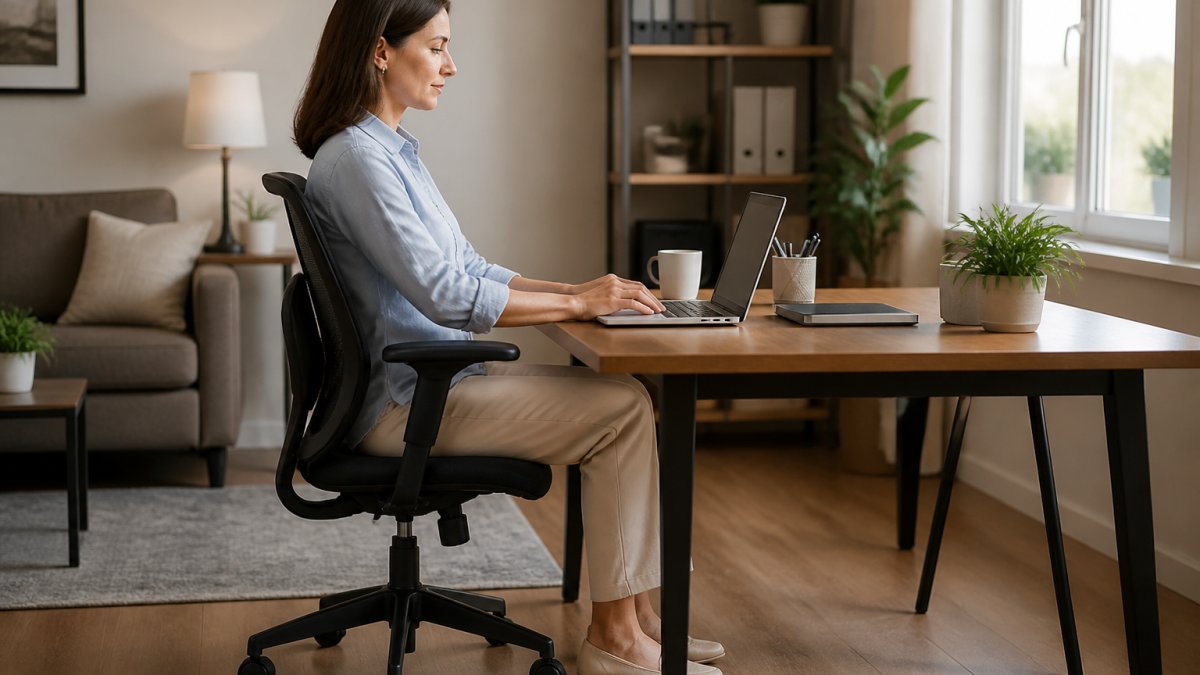
Start with your feet: flat on the floor or a footrest, never dangling, with knees bent at roughly 90 degrees.
Next, press your back against the backrest so your lower back touches the lumbar support rather than hovering.
These positioning principles work whether you're using a posture corrector, an ergonomic chair, or both.
Choosing Between Them: A Practical Framework
The choice depends on four factors: where your pain sits, how long you sit, how much active effort you'll sustain, and what you're willing to spend over time.
Women's Anti-Hunchback Posture Correction Sports Bra with Chest Pad →
Step 1: Locate Your Pain
Where you feel the pain points to which tool helps first.
- Upper back, between the shoulder blades, or base of the neck. This pattern usually tracks with forward head and rounded shoulders from screen work. A posture corrector's proprioceptive feedback is well suited here because the problem is a habit your nervous system keeps repeating. An ergonomic chair helps less, because the chair supports your lower back, not your shoulder girdle.
- Lower back, especially after 30-60 minutes of sitting. This pattern usually tracks with a flattened lumbar curve and sustained static load. An ergonomic chair with adjustable lumbar support addresses this directly. A posture corrector worn while seated does little for the lumbar curve and can even encourage a rigid, braced position that's uncomfortable for long sitting.
- Both, or pain that moves around. This is the most common pattern and usually means the chair is the foundation and the corrector is the supplement, not the reverse.
A useful self-test: sit in your current chair for 20 minutes without a corrector and note when and where discomfort starts, then repeat with one on. Whichever condition delays or reduces the discomfort tells you which mechanism your body responds to.
Step 2: Match the Tool to Your Sitting Load
| Daily seated time | First priority | Second priority |
|---|---|---|
| Under 2 hours | Posture corrector or none | Chair upgrade later |
| 2-4 hours | Posture corrector plus movement breaks | Chair if discomfort persists |
| 4-6 hours | Ergonomic chair | Corrector for the first 2-3 hours |
| 6+ hours | Ergonomic chair, fitted properly | Corrector plus hourly movement |
The logic: the longer you sit, the more passive support matters, because no wearable can hold your posture for eight hours without creating its own strain. If you sit little but slouch while standing or walking, a corrector is more relevant.
Step 3: Be Honest About Consistency
A posture corrector only works while it's on and only pays off with weeks of consistent wear.
A common pattern: people buy a corrector, wear it enthusiastically for a week, then leave it in a drawer. The chair keeps working because it requires nothing from you. If your wearable habits are poor, weight the chair higher.
Step 4: Compare Total Cost, Not Sticker Price
A corrector is inexpensive upfront but may need replacing every 6-12 months as elastic stretches and closures lose grip.
The more important question is whether a corrector can compensate for a badly fitted chair. Usually it can't. If your chair forces your hips higher than your knees, lacks a lumbar curve, or pins your shoulders forward, a corrector fights the chair all day.
What Each Option Realistically Can and Cannot Do
Neither tool is a treatment for back pain. Both change the mechanical load on your spine and the habits around it, and both work best alongside movement, strengthening, and, when pain is persistent, radiating, or accompanied by numbness or weakness, evaluation by a qualified clinician.
What the evidence generally supports:
- Ergonomic chairs with adjustable lumbar support and seat depth can reduce seated discomfort, particularly for long sitters.
- Wearable posture reminders can improve short-term posture awareness and may help build better habits.
- Neither has strong evidence for resolving chronic or structural back pain alone.
What it does not support:
- Claims that a corrector will "fix" your posture permanently.
- Claims that any single chair will eliminate back pain.
- Using either tool as a substitute for diagnosis, strengthening, or movement.
A Practical Starting Plan
If you're unsure where to start, this sequence works for most people:
- Week 1: Fix your workstation setup, feet flat, knees at 90 degrees, lumbar curve supported, screen at eye level. Free, and often the biggest single improvement.
- Weeks 1-2: Add a posture corrector for 1-2 hours daily during your most slouch-prone block.
- Weeks 3-6: Increase corrector wear gradually toward 3-4 hours daily if comfortable, with a 2-minute movement break every 45-60 minutes.
- Ongoing: If seated discomfort persists despite good setup and consistent corrector use, upgrade the chair. If upper-back fatigue persists despite a good chair, extend corrector use.
Can You Use Both Together
Yes, and many people do. A posture corrector worn during the first half of your workday provides active training and muscle engagement, while an ergonomic chair provides passive support throughout the day.
The combination works because they serve different purposes: the corrector builds awareness and habit, while the chair prevents pain when your muscles are fatigued.
Comparison Table
The table below summarizes the practical differences. Read it as a starting point, not a verdict, the notes underneath explain where the numbers can mislead.
| Factor | Posture Corrector | Ergonomic Chair |
|---|---|---|
| Support type | Active (feedback-based) | Passive (structural) |
| Best for | Habit retraining, upper-back and shoulder posture | Long-duration sitting, lower-back support |
| Typical wear/use time | 1-4 hours daily, up to 6 for some users | All day while seated |
| Muscle effect | Encourages postural awareness; may reduce reliance over time | Reduces static strain on lumbar and pelvic muscles |
| Setup effort | Minimal, adjust straps once | Significant, height, depth, lumbar, armrests, tilt |
| Upfront cost | Low | Moderate to high |
| Replacement cycle | Often 6-12 months as elastic and closures wear | Often 5-10 years with occasional part replacement |
| Portability | High, wear anywhere | Low, stationary |
| Speed of perceived relief | Moderate, and only while worn | Often faster for seated lower-back discomfort |
| Evidence strength | Limited; best for awareness and habit | Moderate for reducing seated discomfort |
| Main risk | Over-reliance, skin irritation, shoulder strain from overtightening | Poor fit making things worse; cost sunk into the wrong chair |
How to Read the Cost Row
Sticker price is the least useful number here. What matters is cost per year of daily use.
- A corrector that lasts a year, worn 3 hours a day, works out to a very small daily cost, but only if you actually wear it. If it sits in a drawer, the effective cost is infinite.
- A chair that lasts seven years, used 6 hours a day, works out to cents per seated hour. For heavy sitters, that's usually the better value despite the larger upfront number.
- The worst outcome is buying both and using neither well. Fix the free variables first, desk height, monitor position, movement breaks, before spending on either tool.
How to Read the Evidence Row
"Limited" and "moderate" are doing real work here. Most research on ergonomic seating measures short-term comfort and posture, not long-term pain resolution, and most research on wearable posture devices measures awareness, not pain outcomes.
That doesn't make either tool useless. Judge them on what they reliably do, change mechanical load and build awareness, rather than on promises of a cure.
Where Each Option Fails
- A posture corrector fails when it's worn too long or too tight, used as a substitute for strengthening, or expected to fix lower-back pain from a poorly fitted seat.
- An ergonomic chair fails when it's bought without measuring, never adjusted after delivery, or expected to compensate for 10 hours of uninterrupted sitting.
The Combination That Works
For most people with mixed upper- and lower-back discomfort from desk work, the highest-value setup is a properly fitted ergonomic chair as the foundation, a posture corrector used for a few hours daily as a training tool, and a movement break every 45-60 minutes. The chair handles the load; the corrector handles the habit; the breaks handle everything neither tool can.
Frequently Asked Questions
Is a posture corrector or an ergonomic chair better for back pain?
Neither is universally better, they serve different purposes. A posture corrector provides immediate external support and reminds you to correct alignment, making it useful for acute pain or habit-breaking. An ergonomic chair supports your spine passively throughout the day without requiring conscious effort. For persistent back pain, an ergonomic chair is typically the stronger long-term solution because it works while you sit naturally. Many people benefit from using both: a corrector during transition periods and a quality chair for daily support.
How long should you wear a posture corrector each day?
Start with 1-2 hours daily and gradually increase over 2-3 weeks, reaching 4-8 hours maximum. Wearing one too long can create dependency on external support rather than building your own postural muscles. Limit use to times when you're most likely to slouch, during desk work or commuting. Remove it during exercise and rest periods to allow your muscles to engage naturally. If you experience discomfort or skin irritation, reduce duration and consult a healthcare provider.
Can a posture corrector replace an ergonomic chair?
Not completely. A posture corrector addresses alignment and habit but doesn't provide the lumbar support, seat depth adjustment, or prolonged comfort an ergonomic chair offers. A corrector is best used as a temporary tool or complement to proper seating. For anyone spending 6+ hours daily sitting, an ergonomic chair is essential; a corrector alone cannot substitute for proper workstation setup and chair support during extended sitting.
What features should you look for in an ergonomic chair for back pain?
Prioritize adjustable lumbar support that matches your lower-back curve, seat height adjustment for proper desk alignment, seat depth that supports your thighs without pressure behind knees, and a backrest that reclines slightly. Armrests should support your arms at elbow height, and the chair should encourage active sitting with some movement. Test the chair if possible, comfort varies by body type and existing pain patterns. Quality matters; a well-designed chair reduces strain throughout the day without requiring conscious posture correction.